DC Fast Charging
DC Charger Cabinet Cooling: Air Paths, Filters and Cleaning
How air-cooled DC fast chargers move air through the cabinet, why filters and clearance matter in dusty or hot sites and a cleaning schedule to start from.
- Prepared by
- VULTAE Engineering Team
- Published
- Reading time
- 2 min
- Sources
- —
Key takeaways
- 1Most DC chargers move air through the cabinet with fans, across the power modules and out of an exhaust. Heat, dust and blocked filters are the usual reasons a charger derates or trips.
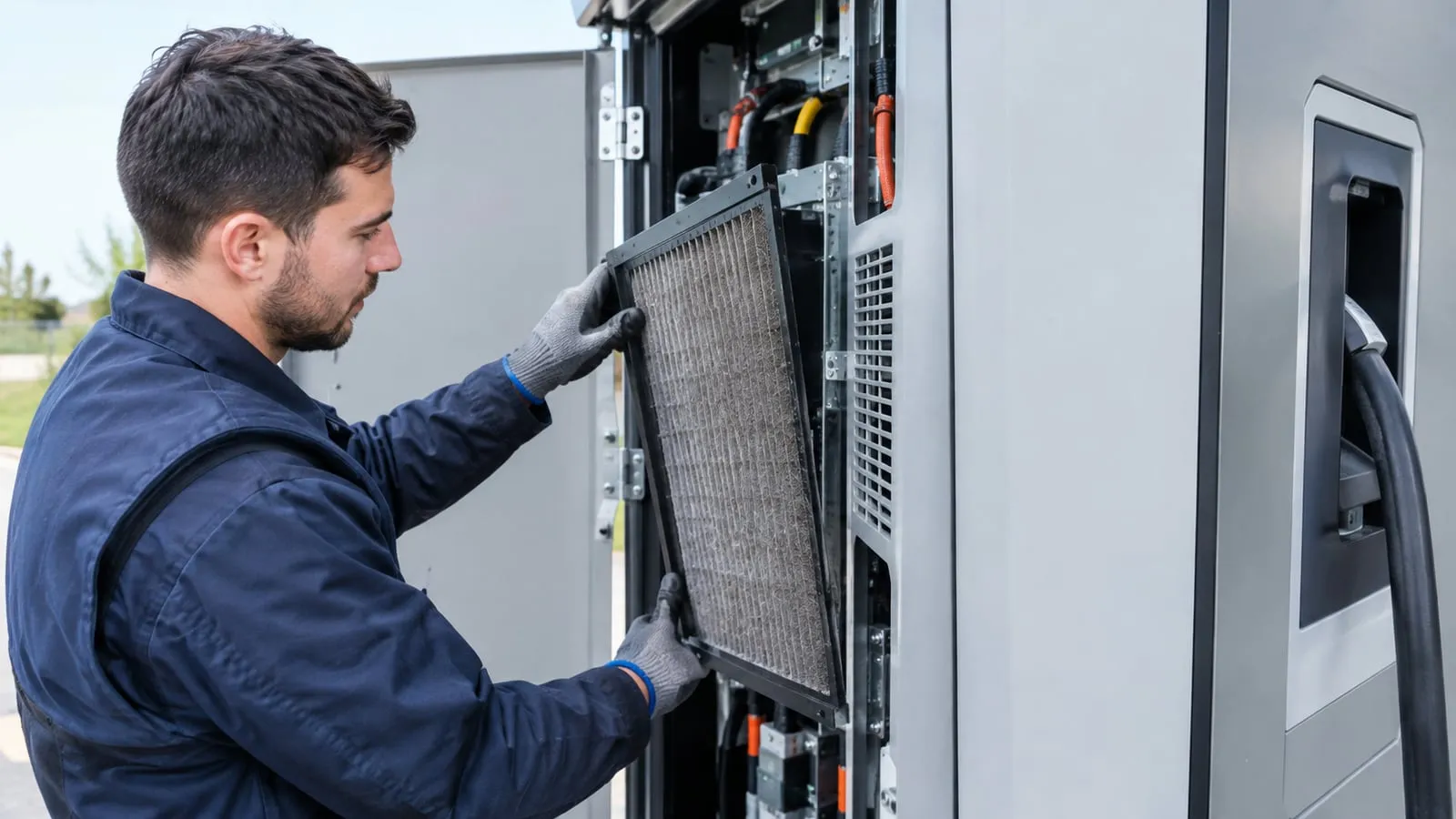
- 2Keep clearance around the intake and exhaust, protect the unit from direct sun and clean or replace filters on a schedule that matches the site: weekly sand or monthly dust is not the same as a clean car park.
- 3Ask the supplier how the cabinet is cooled, what the filter is, how often it needs cleaning and which parts of the cooling path are replaceable on site.
Contents
Short answer: an air-cooled DC charger needs clean filters, free intake and exhaust and shade to hold full power. Put a cleaning schedule in the maintenance plan and check the temperature logs.
How air moves through the cabinet
| Part | Role | What goes wrong |
|---|---|---|
| Intake with filter | Lets cool air in, keeps dust out | Blocks with dust, leaves, sand |
| Fans | Push air across the modules | Bearings wear, speed drops |
| Power modules | Convert AC to DC and make heat | Overheat when airflow is poor |
| Internal baffles and ducts | Direct air to the hot parts | Left open after service |
| Exhaust | Releases hot air | Blocked by walls or recirculation |
In modular designs each power module has its own fan, so a failed fan may reduce power rather than stop the charger. For module design see power modules: modularity, redundancy and repair.
Site factors
- Clearance: keep the intake and exhaust sides free by the distance in the manual. Do not stack equipment against them.
- Direction: do not let one charger blow hot air into the intake of another or of a transformer.
- Sun: a canopy or shade lowers cabinet temperature; see solar carports and canopies.
- Dust and sand: use filters and a cleaning plan; see enclosures for coastal and desert sites.
- Moisture and salt: corrosion attacks fans and connectors in coastal air.
Cleaning schedule to start from
| Site | Filter check | Notes |
|---|---|---|
| Clean urban car park | Monthly | Quarterly if logs look good |
| Roadside or industrial | Every 2–4 weeks | More after construction work |
| Desert, sand, quarries | Weekly | Consider spare filter sets |
| Cottonwood or leaf season | Weekly | Check intake grills too |
Record the date, the condition and the module temperatures in the maintenance checklist.
What to watch in the logs
- Module or cabinet temperature trending up on similar loads.
- Fan speed alarms or fan failure events.
- Derating events on hot afternoons.
- Repeated trips after long sessions.
Remote diagnostics can send these as alerts before a failure; see remote diagnostics.
Questions for the supplier
| Question | Why |
|---|---|
| Is the cabinet air-cooled? Fan count and redundancy | Failure behaviour |
| Filter type, size and replacement part | Maintenance |
| Rated ambient range and derating behaviour | See operating temperature range |
| Which cooling parts can be replaced on site? | Downtime |
| What dust and moisture protection is fitted? | Site suitability |
For hot-site planning see EV chargers in hot climates. VULTAE can give you the cooling concept and spare parts list for the DC series you are considering.
Questions buyers ask
- How often should I clean the filters?
- Start with a monthly check and adjust by site. Dusty or sandy locations, construction nearby or cottonwood season can need weekly cleaning. The manual and your logs will tell you the right interval.
- Why does a charger lose power in hot weather?
- Rising component temperature triggers derating to protect the modules. Better airflow, shade and clean filters delay it. See the articles on hot climates and the operating temperature rating.
- Is liquid cooling the same as a cooled cabinet?
- No. Liquid cooling of the charging cable removes heat from the cable at high current. Cabinet cooling removes heat from the power electronics. They are separate systems.