Sites & Applications
Solar Carports and Canopies Over Charging Bays
Solar carports over EV charging bays: how much energy panels give, direct vs grid-tied use, structure and wind loads, shade benefits and permits.
- Prepared by
- VULTAE Engineering Team
- Published
- Reading time
- 2 min
- Sources
- 2 references
Key takeaways
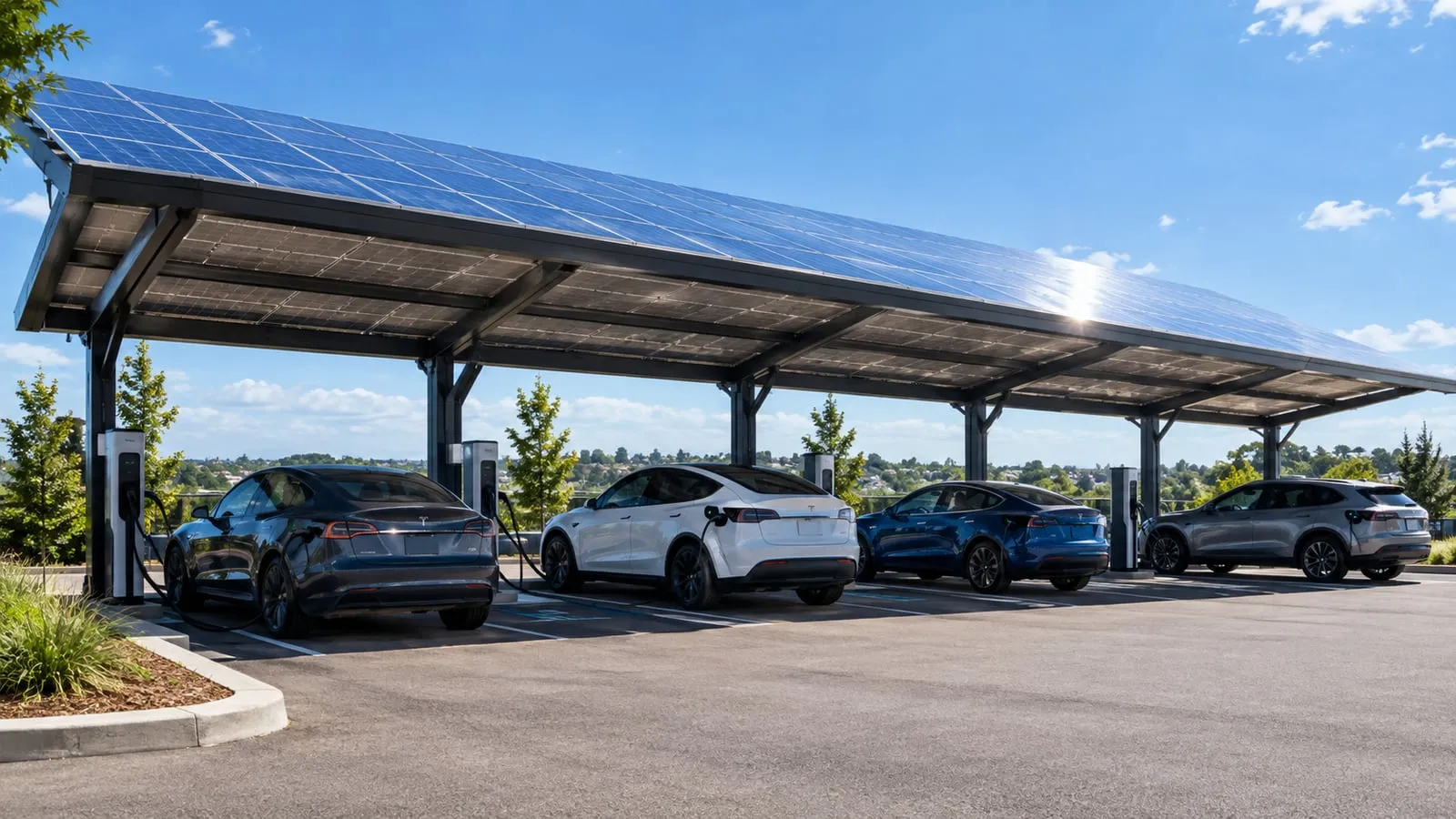
- 1A solar carport gives shade, weather protection and energy. About 5–6 m² of panel per parking bay is typical; a 100-bay carport hosts roughly 100–120 kWp, and more if the canopy extends beyond the bays.
- 2A kWp of panels yields roughly 900–1,800 kWh per year, depending on sun and climate. A car using 16 kWh/100 km driving 12,000 km needs about 1,900 kWh a year — so ~1–2 kWp per car covers the yearly energy on average, if the timing matches.
- 3Most solar energy is made at midday and most charging happens in the evening or overnight. Without storage or tariffs that reward daytime charging, the match is partial. Workplaces and fleets that charge by day match much better.
- 4Costs and permits depend on structure height, wind and snow loads, foundations and grid connection. Plan the canopy and the electrical works together.
Contents
Short answer: a solar carport gives shade, shelter and energy over the bays. Plan about 5–6 m² of panel per bay, 1–2 kWp per car for yearly energy, and remember that solar peaks at midday while most charging happens in the evening — so the match is best for workplaces and fleets or with storage and solar-aware chargers.
Sizing
| Item | Typical value |
|---|---|
| Panel area per bay | 5–6 m² |
| Panel power per bay | about 1–1.2 kWp (at ~200 W/m² panels) |
| Yield | 900–1,800 kWh per kWp per year, depending on location |
| Car energy use | about 1,900 kWh/year (12,000 km at 16 kWh/100 km) |
| 100-bay carport | about 100–120 kWp |
A parking bay is about 12–14 m², so a canopy that extends beyond the bays can carry more panel area per bay than the figures above.
Timing: solar vs charging
| Site | Charging time | Solar match |
|---|---|---|
| Workplace | Daytime | Good |
| Fleet depot (day shift) | Daytime | Good |
| Retail, mall | Daytime | Good |
| Apartment building | Night | Poor without storage |
| Hotel | Night and morning | Medium |
| Highway | Any time | Medium |
Improve the match with solar-aware charging (the charger follows the surplus), battery storage, smart scheduling and time-of-use tariffs. See solar-aware charging and smart charger features.
Structure and site
- Wind and snow loads decide steel size and foundations; canopies catch wind like sails.
- Height for vehicle clearance, including vans and trucks.
- Drainage of roof water away from bays and chargers.
- Cable routes inside columns, with protection and fire considerations.
- Foundations and underground services.
- Lighting integrated under the canopy.
- Heat: canopies lower surface and cabinet temperatures — see hot climates.
Electrical design
The panels connect to an inverter on the site’s electrical system. Chargers draw from the site, with load management and metering of solar and charging. Plan the grid connection, export limits, and protection. See load management and installation requirements.
Economics (approach)
Compare:
- Cost of the carport per kWp vs a rooftop system (carports cost more because of the structure).
- Value of energy used on site and exported, plus any incentives.
- Value of shade and shelter, which can increase use and revenue of charging bays.
- Maintenance and cleaning.
Use your own prices; we do not quote them here. For charging station economics see is EV charging profitable.
Permits
Structures usually need building permits; grid connection needs approval from the utility. Start early. Fire and safety review may apply for large canopies with batteries.
VULTAE chargers on solar sites
VULTAE smart AC chargers support solar-surplus load balancing and OCPP load management, and DC chargers fit under canopies with proper clearance. Share your canopy dimensions and supply with us when you ask for a quote. See wall-mounted vs pedestal for mounting under canopies.
Questions buyers ask
- How many solar panels do I need to charge an electric car?
- For average driving of 12,000 km a year at 16 kWh/100 km, a car uses about 1,900 kWh. At 1,000–1,500 kWh per kWp per year, 1.5–2 kWp of panels covers it on an annual basis; timing and storage decide how much you use directly.
- Can solar panels charge the car directly?
- Electrically the panels feed the site’s grid-tied inverter, and the charger draws from the site. Solar-aware chargers adjust their power to the surplus so that more of the charging uses solar energy. Pure off-grid charging needs batteries.
- Do solar carports need planning permission?
- Usually yes, as they are structures. Height, wind and snow loads, and local rules decide. Check early; permits and grid connection often set the schedule.
- Is a solar carport worth it without feed-in tariffs?
- It can be, if you use the energy on site (chargers, building, fleet) and value shade and shelter. Compare with a rooftop system, which is usually cheaper per kWp.
References
- [1]IEC 60364-7-722:2018 — supplies for electric vehicles. International Electrotechnical Commission.
- [2]IEA Global EV Outlook 2025. International Energy Agency.