Installation & Power
EV Chargers for Hot Climates: Derating, Cooling and Shade
What heat does to EV chargers: derating, cooling, sun load, sand and dust, canopy shade, +55 °C ratings and questions to ask for Gulf and tropical sites.
- Prepared by
- VULTAE Engineering Team
- Published
- Reading time
- 3 min
- Sources
- 3 references
Key takeaways
- 1Heat reduces charger output (derating), shortens component life and trips protection. Ambient temperature, direct sun on the cabinet and poor airflow all add up — the inside of a cabinet in the sun can be much hotter than the air.
- 2Look for the rated operating temperature range and for the derating curve: at what temperature does power start to fall and by how much? A charger rated to +55 °C is the benchmark for Gulf markets.
- 3Shade, airflow and clean filters often matter more than the number on the data sheet. A canopy over the charger and the car can lower the cabinet temperature considerably.
- 4Fine dust is the second enemy: filters, sealed electronics and cleaning routine decide the life of the cooling system. See the coastal and desert enclosure article for corrosion.
Contents
Short answer: heat makes a charger slow down (derate), wears components faster and can trip protection. Choose a charger rated to +55 °C, ask for the derating curve, give it shade and airflow, and plan filter cleaning for dust. Site design often matters as much as the data sheet.
What heat does
| Effect | Mechanism | Result |
|---|---|---|
| Derating | The charger cuts output when internal temperatures rise | Slower charging on hot afternoons |
| Shorter life | Capacitors, fans and power modules age faster with temperature | More failures after a few years |
| Protection trips | Over-temperature protection stops the session | Sessions interrupted |
| Cable and connector heating | High current in a hot connector | Connector protection reduces current |
| Plastic ageing | UV and heat crack or yellow plastics | Cracks and water entry |
Sun on a dark cabinet adds heat on top of air temperature. At 45 °C air temperature the inside of an unshaded cabinet can be much hotter.
Specifications to compare
| Item | What to look for |
|---|---|
| Operating temperature | The upper limit — +55 °C for Gulf-grade — and the lower limit |
| Derating curve | Power vs ambient temperature; where it starts and how steep |
| Cooling type | Forced air, liquid-cooled power electronics, or sealed with heat exchanger |
| Air intake filtering | Washable filter, easy access |
| Enclosure colour and material | Light colours reflect heat; coatings help |
| IP and corrosion class | See IP and IK ratings |
| Altitude | Thin air cools less; many ratings are up to 2,000 m |
Dubai’s technical requirements for public chargers ask for operation up to 55 °C ambient, so that rating is a useful benchmark across the Gulf — see the UAE guide and the Saudi Arabia guide.
Site design for heat
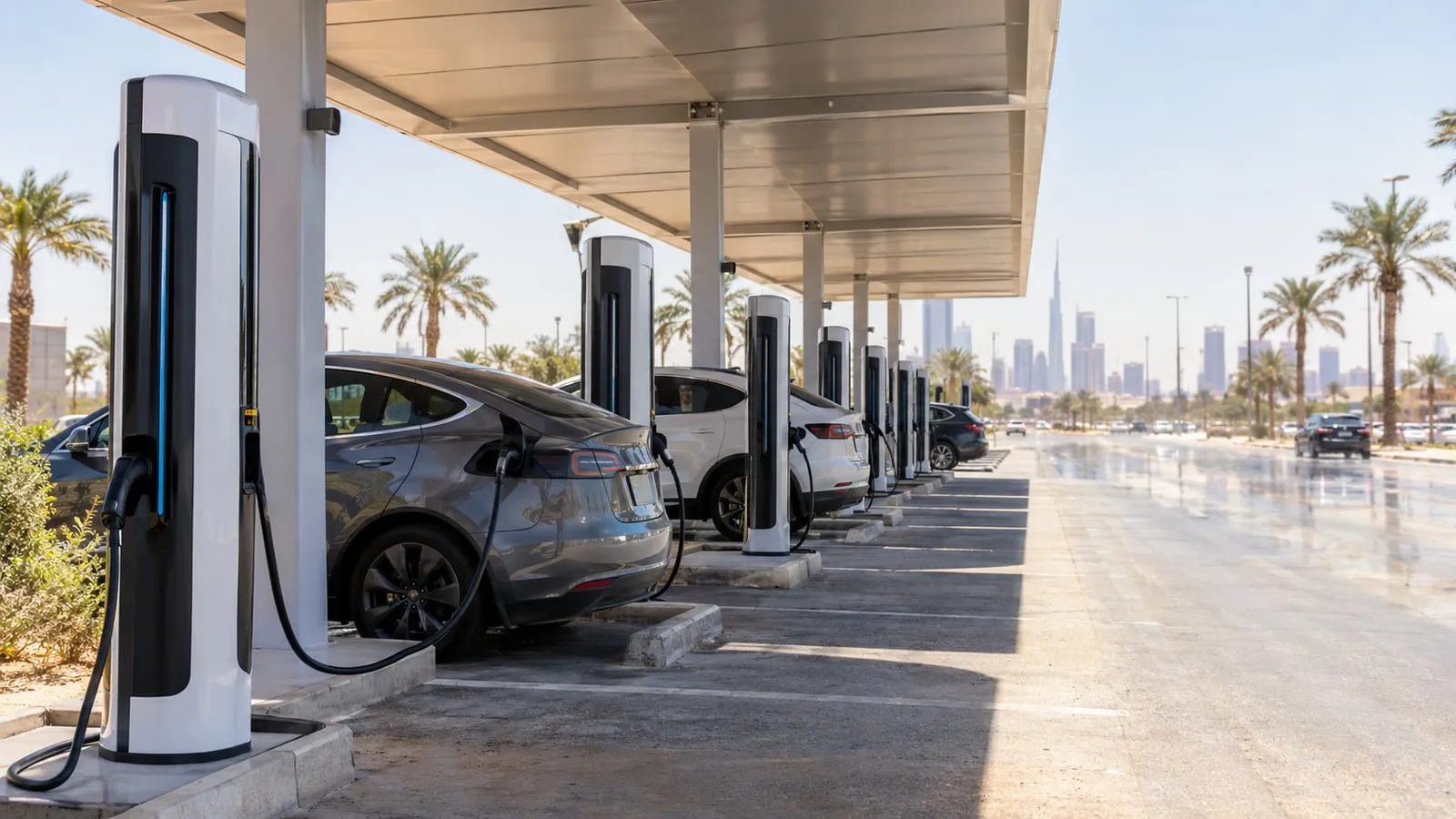
- Shade. A canopy over chargers and bays lowers cabinet temperature and car heat. Keep it open at the sides for airflow.
- Orientation. Put the cabinet’s hot face away from the afternoon sun where the layout allows.
- Spacing. Leave room around vents; avoid walls that reflect hot air back.
- Ground surface. Dark asphalt radiates heat; light surfaces help.
- Ventilation of equipment rooms. If power electronics are in a room, size cooling for the heat loss.
- Cable routes. Avoid laying cables where they get direct sun for long stretches.
For canopy design with solar panels see solar carport charging.
Dust and sand
Fine dust blocks filters and coats heat sinks. The result is overheating that looks like a heat problem. Remedies:
- Filtered air intakes with washable filters.
- A cleaning schedule based on the site: weekly in dust-storm areas, monthly elsewhere.
- Spare filters on site.
- Sealed electronics (conformal coating) for boards.
The maintenance steps are in the maintenance checklist; corrosion and salt are covered in coastal and desert enclosures.
Questions for the supplier
- What is the rated ambient range, and is +55 °C a full-power rating or a derated one?
- Show the derating curve and the test report for temperature rise.
- How are the power modules cooled, and what is the filter maintenance interval?
- Which materials and coatings resist UV and heat?
- Are there hot-climate references? (Ask for real, verifiable ones.)
VULTAE chargers
VULTAE chargers are specified for operation up to +55 °C, and lower limits of −20 °C or −25 °C depending on the series. The derating curve and the filter specification depend on the model — ask for them in writing with your enquiry, and include the shade and dust plan in the installation requirements for your site.
Questions buyers ask
- What temperature can an EV charger operate at?
- It depends on the model. Many chargers list operating ranges from −20 or −25 °C up to +50 °C or +55 °C. Dubai’s technical requirements for public chargers ask for operation at an ambient temperature up to 55 °C. Always check the data sheet and the derating curve.
- What is derating?
- The charger lowers its output power when internal temperatures get high, so that components stay within limits. A good design derates gradually at the top of its range; a poor one derates early, so drivers charge slowly on hot days.
- Does a shade canopy help?
- Yes. Direct sun can heat a cabinet well above ambient air temperature. A canopy lowers that heat and also makes the site more pleasant for drivers. Leave space for airflow and make sure the canopy does not trap hot air.
- How should I handle dust and sand?
- Use chargers with filtered air intakes or sealed designs, clean filters on a schedule that matches the site (weekly to monthly in desert areas), and keep spare filters. Dust blocking filters is a common cause of overheating.
References
- [1]IEC 61851-1:2017 — general requirements. International Electrotechnical Commission.
- [2]IEC 61851-23:2023 — DC electric vehicle supply equipment. International Electrotechnical Commission.
- [3]WAM: Dubai’s charging points. Emirates News Agency.