Country guide · United Arab Emirates
EV Chargers in the UAE: Standards, Approvals, Climate and Site Configurations
What an EV charger must meet in the UAE: Type 2 and CCS2 only for public sites in Dubai, 55 °C rating, OCPP, federal EVSE regulation and emirate approvals.
- Prepared by
- VULTAE Engineering Team
- Published
- Reading time
- 12 min
- Sources
- 11 references
At a glance
- Grid supply
- 230 / 400 V, 3-phase, 50 Hz
- AC connector
- Type 2 (IEC 62196-2)
- DC connector
- CCS2
- Design ambient
- 55 °C at full output (DEWA)
- Minimum protection
- IP54 · IK10 (DEWA spec)
- Backend protocol
- OCPP 1.6J or higher
- Federal product rule
- Cabinet Resolution 175 / 2025
- Public charging fee
- AED 1.20 / 0.70 per kWh + VAT
Key takeaways
- 1For public charging in Dubai, only Type 2 (AC) and CCS2 (DC) connectors are allowed. CHAdeMO, GB/T, CCS1, NACS and Type 1 are prohibited on public chargers.
- 2DEWA’s technical regulation (May 2025) asks every charger to run at full output at 55 °C ambient and up to 95 % humidity — check the datasheet temperature line before anything else.
- 3Since 27 May 2026, chargers placed on the UAE market fall under Cabinet Resolution No. 175 of 2025 (federal EVSE regulation, conformity assessment by MoIAT). Emirate rules (DEWA in Dubai, DoE and QCC in Abu Dhabi) apply on top.
- 4Paid public chargers in Dubai also need a certified energy meter, an EVSE-ID, a metal nameplate, OCPP 1.6J or later and at least one authorisation method (RFID, QR, app or Plug & Charge).
- 5Charging fees are set nationally: AED 1.20 per kWh plus VAT for fast charging and AED 0.70 per kWh plus VAT for slow charging (Cabinet Resolution No. 81 of 2024).
Contents
Short answer: a charger for a public site in the UAE should be a Type 2 AC or CCS2 DC unit that runs at full output at 55 °C, carries at least IP54 / IK10, talks OCPP 1.6J or later, and can be certified under the federal EVSE regulation (Cabinet Resolution No. 175 of 2025). In Dubai, DEWA approves the connection and licenses public operators; in Abu Dhabi, the Department of Energy and the Quality and Conformity Council set the rules. The rest of this guide explains each requirement and what it means for the equipment you order.
This guide is written for charge point operators, developers, contractors and distributors buying chargers for the UAE. It summarises public documents as of October 2026 — regulations change, so confirm the current version with the authority before you sign a contract.
The UAE market in numbers
Electric mobility in the UAE is moving from pilot to infrastructure. A few figures from official sources:
| Indicator | Figure | Source and date |
|---|---|---|
| EV charging points in Dubai (DEWA and licensed operators) | More than 1,270 | WAM, August 2025 |
| Electric vehicles in Dubai | More than 40,600 | DEWA, first half of 2025 |
| Users registered on DEWA’s EV Green Charger scheme | 20,903 | DEWA, end of Q1 2025 |
| UAEV federal fast-charging network target | 1,000+ chargers by 2030 | Ministry of Energy and Infrastructure / Etihad WE |
| Public charging fee, fast / slow | AED 1.20 / AED 0.70 per kWh + VAT | Cabinet Resolution No. 81 of 2024 |
Three things follow for an equipment buyer. Demand is concentrated in Dubai and Abu Dhabi; the federal network (UAEV, a joint venture of the Ministry of Energy and Infrastructure and Etihad Water and Electricity) is building fast chargers along inter-emirate routes and in the Northern Emirates; and because the end-user price per kWh is fixed nationally, operators compete on location, uptime and charging speed rather than price — which puts the weight of the business case on equipment reliability.
Who regulates what
The UAE has a federal layer for products and an emirate layer for connection and operation. A charger has to pass both.
| Level | Authority | What it controls |
|---|---|---|
| Federal | Ministry of Industry and Advanced Technology (MoIAT) | Product conformity of EV supply equipment under Cabinet Resolution No. 175 of 2025, through the Emirates Conformity Assessment Scheme (ECAS) |
| Federal | Cabinet | Public charging fees (Resolution No. 81 of 2024) |
| Dubai | Dubai Electricity and Water Authority (DEWA) | Technical regulation for chargers, grid connection, charge point operator licences, EVSE-ID |
| Abu Dhabi | Department of Energy (DoE) | Regulatory policy for charging infrastructure: ownership, supply, connection, tariffs |
| Abu Dhabi | Quality and Conformity Council (QCC) | Abu Dhabi certification scheme for EV supply equipment (product certification or registration) |
| Sharjah, Northern Emirates | SEWA; Etihad Water and Electricity | Connection to their networks — ask the utility for its current EV charging procedure |
The federal EVSE regulation
Cabinet Resolution No. 175 of 2025 is the UAE’s technical regulation for electric vehicle supply equipment. It was issued in November 2025 and entered into force on 27 May 2026. It covers the technical and metrological requirements of chargers — minimum quality and operating requirements, the accuracy of the energy measurement used for paid charging and invoicing, and conformity assessment for chargers that are imported or made locally. Wireless charging and some special-purpose systems are outside its scope.
In practice this means the supplier (importer, distributor or manufacturer) needs a conformity certificate for each charger model before it is placed in public use, issued through MoIAT’s ECAS process on the basis of test reports from an accredited laboratory. Plan this before the first shipment: a model that only has CE paperwork is not automatically a UAE-certified model.
Dubai: DEWA’s technical regulation
DEWA published its EV Charging Technical Regulations (version 1.0) in May 2025. It is the most detailed public document in the region and it is the one most purchase specifications in Dubai now copy. The key points:
- Approval first. Organisations and developers need DEWA approval before installing, operating or maintaining a charger connected to DEWA’s network. Public paid charging is run by licensed charge point operators.
- Standards. Chargers comply with the IEC standards listed in the regulation — IEC 61851 (charging systems), IEC 62196 (connectors), IEC 61851-21-2 (EMC for off-board chargers), IEC 60529 (IP code), IEC 62262 (IK code) and the metering standards below.
- Installation. Work follows the IET Code of Practice for EV charging equipment installation and the IET Wiring Regulations (BS 7671), carried out by DEWA-enrolled consultants and contractors.
- The manufacturer has a role on site. DEWA expects the equipment maker to train and certify the local installation team, provide full installation and maintenance instructions, review the electrical and civil design and carry out a quality inspection of the installed equipment.
Electrical and connector requirements
| Requirement (DEWA, 2025) | AC chargers | DC chargers |
|---|---|---|
| Supply | 230 V 1-phase or 400 V 3-phase, 50 Hz, TN earthing | 400 V 3-phase, 50 Hz |
| Connector (public) | Type 2, IEC 62196-2 | CCS2, IEC 62196-3 |
| Charging mode | Mode 3 | Mode 4 |
| Reference rating in the spec | 2 charging points × 22 kVA (32 A per phase), 44 kVA input | Output 50–1,000 V DC, up to 500 A / 500 kW, 95 % efficiency |
| Residual current protection | 30 mA, Type A, auto-recovery | 30 mA, Type A, auto-recovery |
| Protection degree | IP54 / IK10 | IP54 / IK10 |
| Noise | < 60 dB at 1 m | < 60 dB at 1 m |
| Short-circuit withstand at the site | 40 kA for 1 s | 40 kA for 1 s |
Connectors are the first filter. DEWA limits public chargers to Type 2 for AC and CCS2 for DC, and explicitly prohibits SAE J1772, Type 1, CCS1, NACS, CHAdeMO and GB/T on public equipment. Private chargers for restricted use may use other connectors if they meet DEWA’s electrical requirements. Mode 1 and Mode 2 charging with extension cords is restricted. Outside Dubai the rules are less explicit, but Type 2 and CCS2 match the UAE vehicle fleet and are the safe default everywhere in the country.
Requirements for paid public chargers
If the charger will bill drivers, DEWA adds a second set of requirements. These are the items most often missing from a low-cost quotation:
| Item | What is required |
|---|---|
| EVSE-ID | Unique ID per charging point in the format AE*{operator}*E{ID}, visible on the charger and matching the licence application |
| Nameplate | Engraved aluminium or stainless-steel plate outside, plus a duplicate inside: operator name and helpdesk, manufacturer and model, rated voltage, frequency, current, phases |
| Energy meter (AC) | Certified to IEC 62052-11; accuracy class 1 for direct connection (0.5S for LV CT, 0.2S for HV CT/VT) |
| Energy meter (DC) | Certified to IEC 62053-41; class 1 for direct connection |
| Session information | Energy delivered in kWh shown on the charger display, the operator’s app or the vehicle |
| Authorisation | At least one of: RFID (ISO/IEC 14443 A/B), QR code, operator app, Plug & Charge (ISO 15118) |
| Back end | Reports to the operator’s CPMS over OCPP 1.6J or a higher version |
| Data | Designed to protect user data under Dubai’s data law |
| Grid metering | Provision for a DEWA smart electricity meter; DEWA bills the energy the unit consumes |
When you compare quotations, ask every supplier to fill in this table for the exact model offered. A DC charger with an uncertified internal meter, or without an EVSE-ID plate, will not pass a paid-charging licence application.
Climate: design for 55 °C, dust and salt
DEWA asks for chargers that run at full capacity at up to 55 °C ambient and 95 % relative humidity, indoors or outdoors. This single line rules out many products: a lot of chargers are rated to 50 °C and reduce their output above it. Because the regulation says full capacity, look at the derating curve, not only the maximum temperature.
What else the UAE climate asks of the hardware:
- Direct sun. Enclosure surfaces in summer sun run far above air temperature. Light-coloured housings, a canopy or shade structure, and UV-stable cables and holsters extend the life of everything on the outside of the charger.
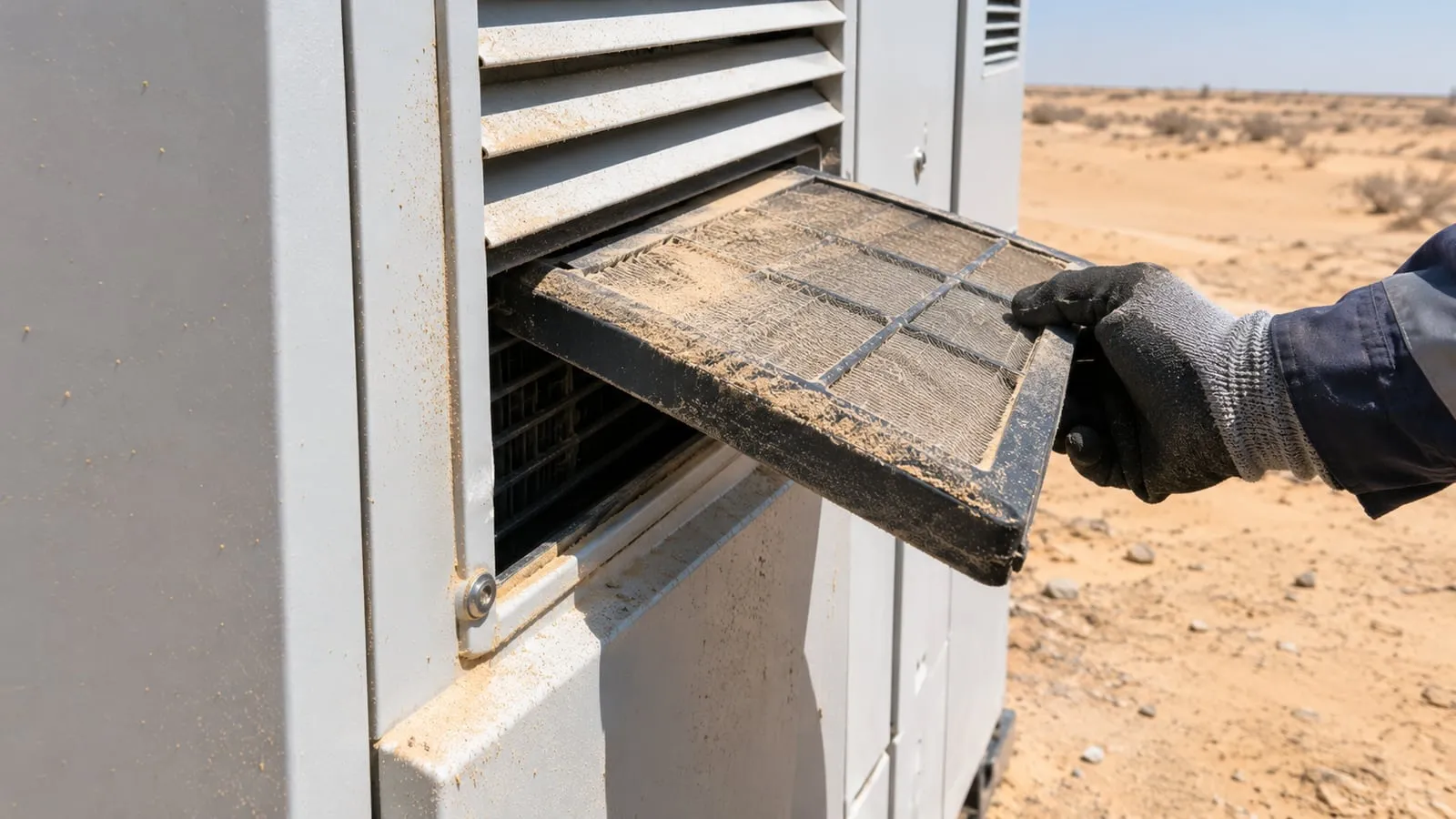
- Dust and sand. IP54 is DEWA’s minimum. For DC chargers with forced-air cooling, ask how the air filters are accessed and how often they need cleaning in desert conditions — a clogged filter is a common cause of derating and faults.
- Coastal salt. Sites in Dubai, Abu Dhabi and Sharjah near the sea need a corrosion-resistant finish (for example a C4 or C5 coating class) and stainless fixings.
- Condensation. Chargers moved between air-conditioned basements and humid outdoor air, or switched on after shipping, can condense internally. Specify anti-condensation heaters for DC cabinets and allow the equipment to acclimatise before energising.
Recommended configurations by site
The table below is a starting point for sizing. Power levels assume Type 2 and CCS2; your consultant confirms the supply and DEWA or the local utility approves the connection.
| Site | Typical choice | Why |
|---|---|---|
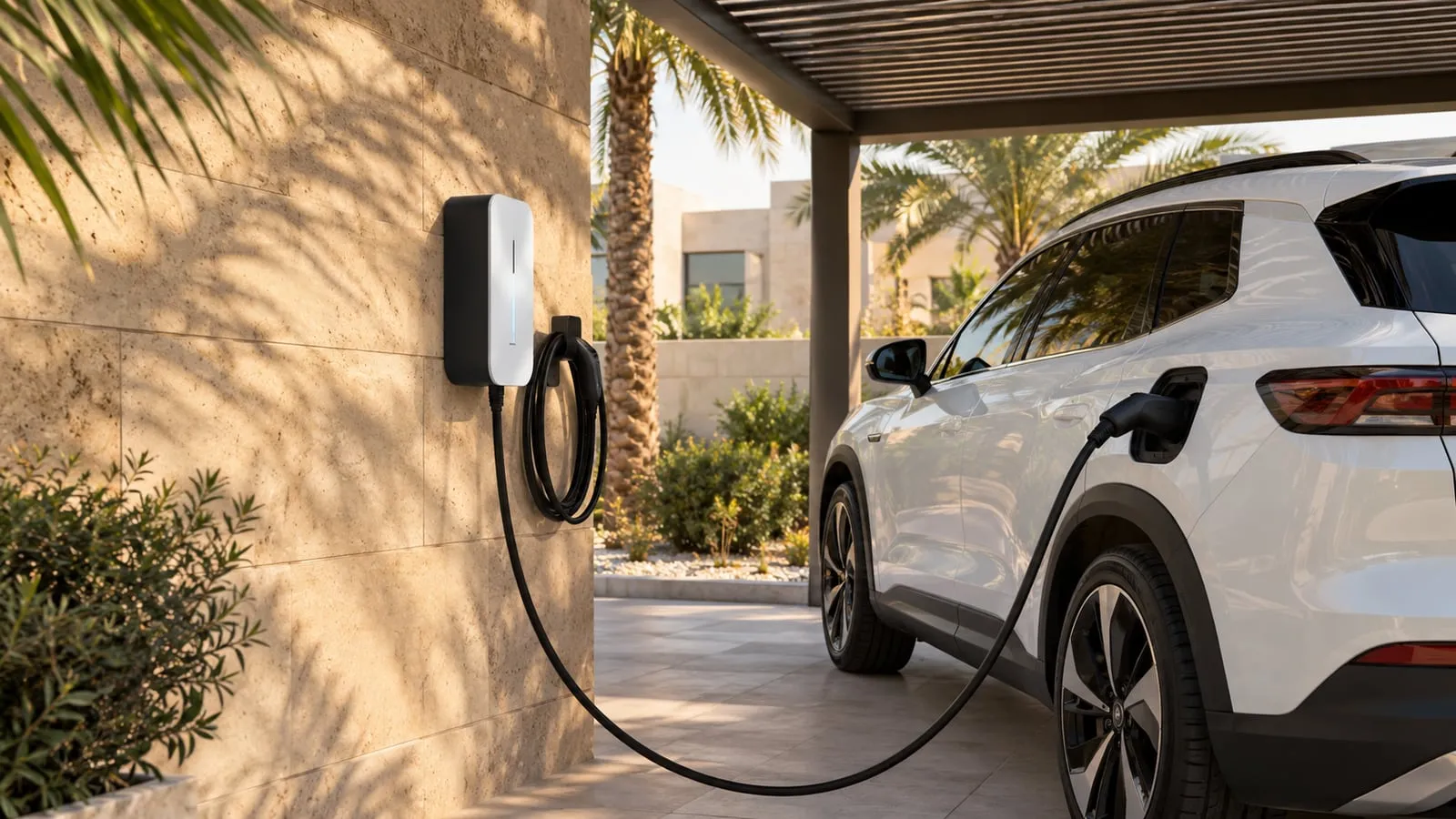
| Villas and private residences | 7–11 kW AC wallbox, Type 2 | Overnight charging; 3-phase supply is common in villas |
| Apartment and office car parks | Dual-port AC posts, 2 × 7–22 kW, with load management | Long dwell times; load management spreads limited building capacity across many bays |
| Hotels and malls | Dual-port AC posts plus one or two 60–120 kW DC chargers | AC for overnight and long stays, DC for short visits |
| Fuel stations and city fast-charging | 120–180 kW dual-gun DC; compact cabinets where bays are tight | 20–40 minute stops; two vehicles per cabinet |
| Inter-emirate highway hubs | 160–300 kW dual-gun DC | High-power vehicles and short stops on long trips |
| Taxi, ride-hailing and delivery fleets | 60–120 kW DC at the depot, AC for overnight | Predictable duty cycles; size by daily kWh per vehicle |
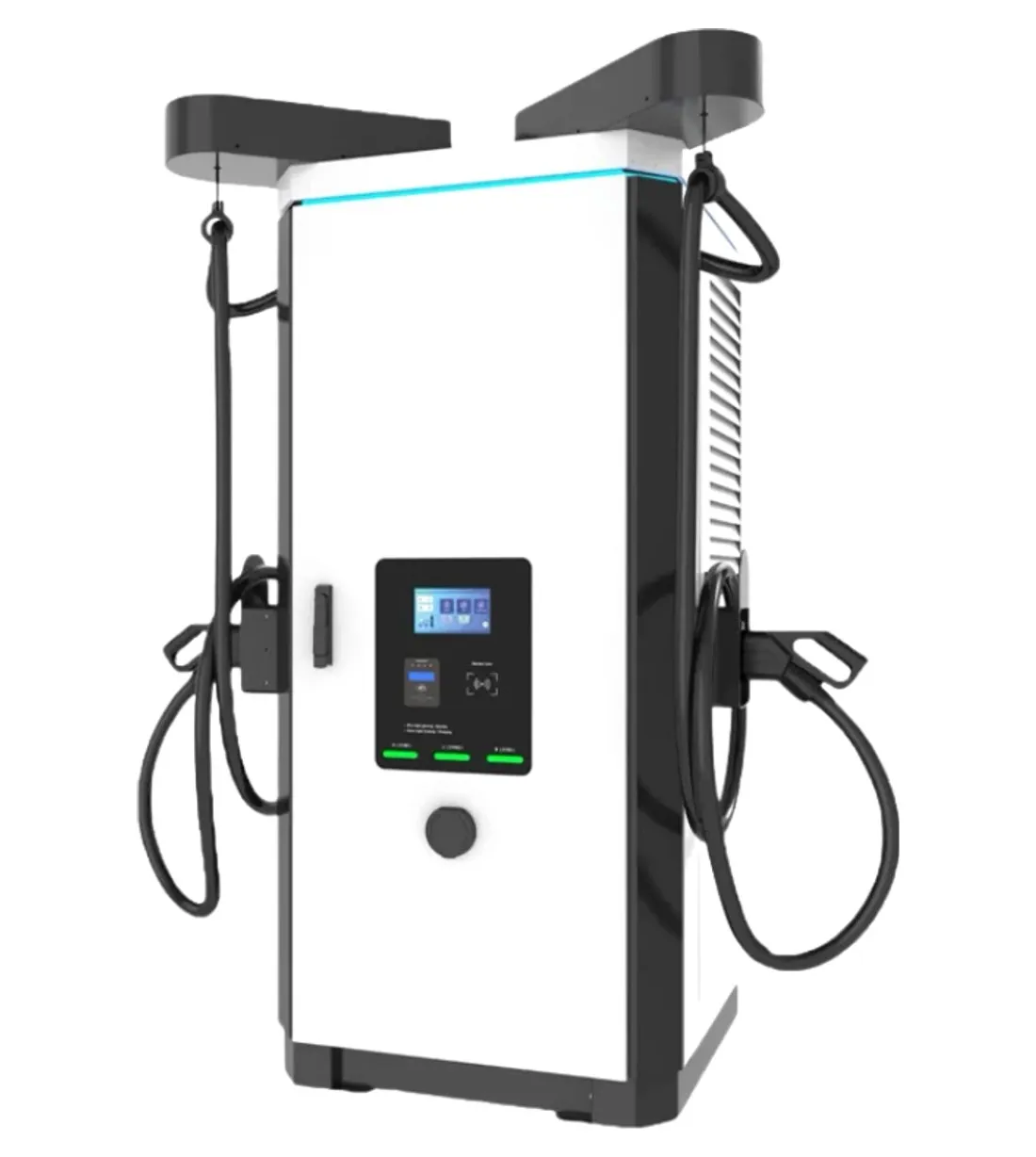
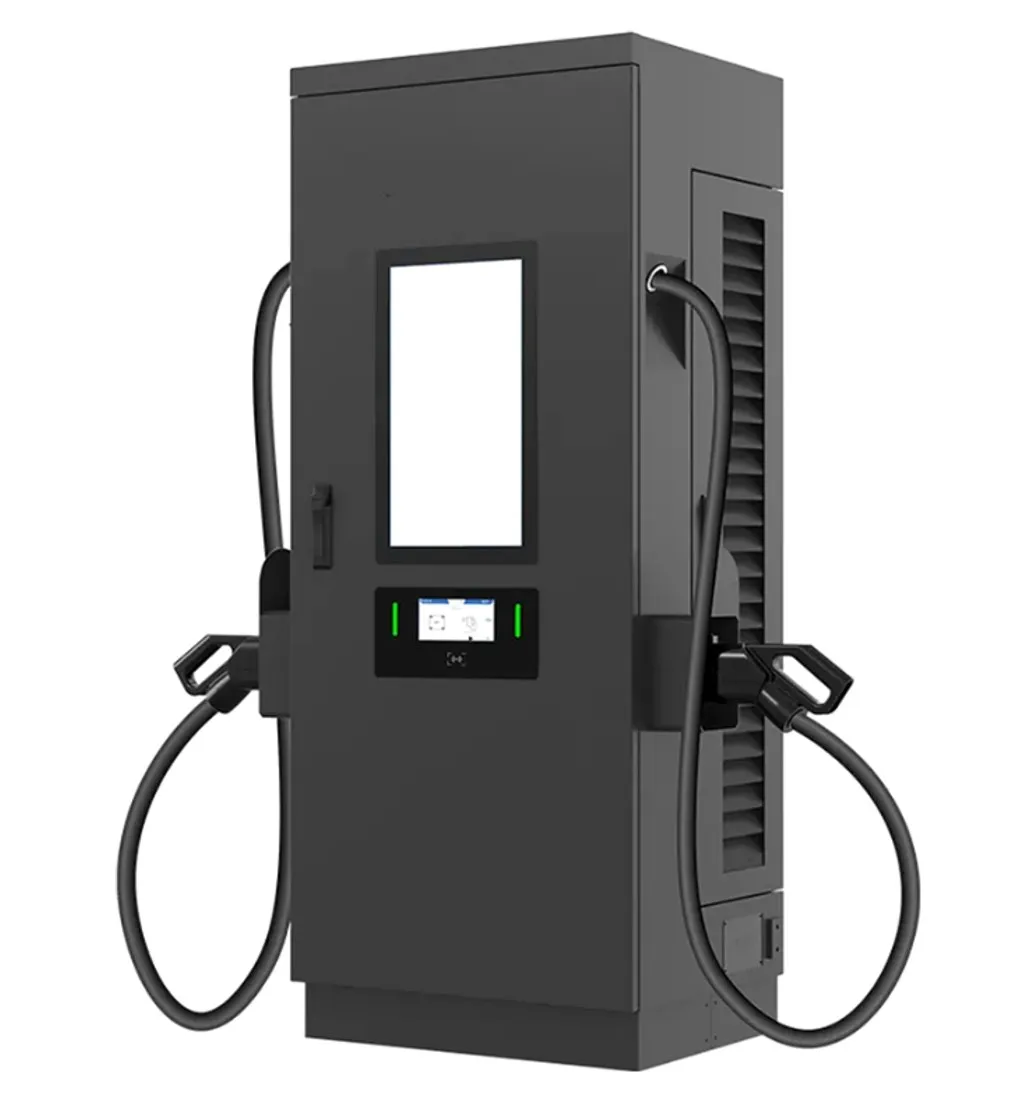
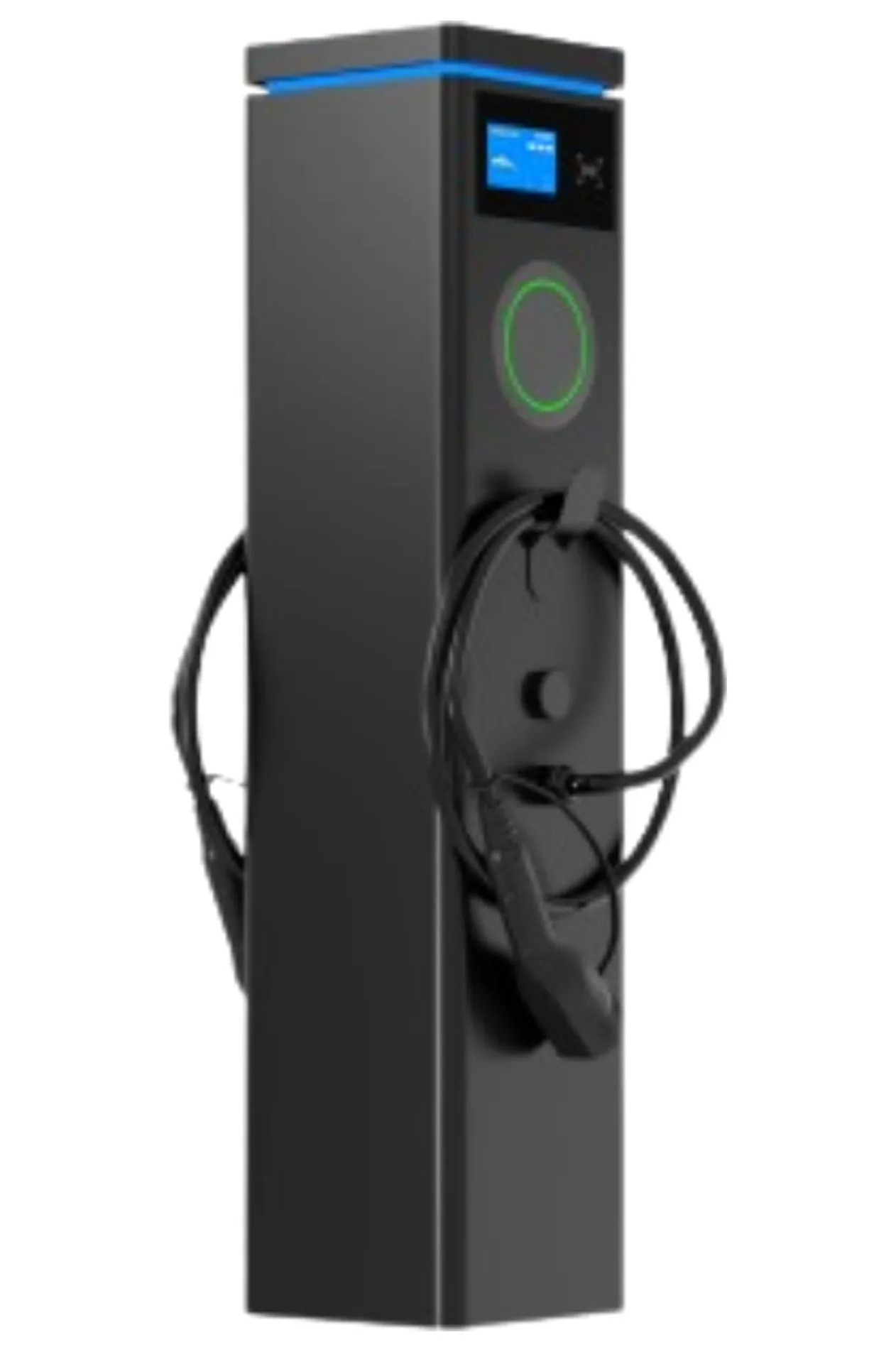
Where VULTAE fits. Every series we offer for the UAE is built for this climate: operation up to +55 °C, Type 2 or CCS2 connectors, OCPP 1.6J / 2.0.1, RFID and QR authorisation, and a C4 anti-corrosion finish option on DC cabinets for coastal sites. For the site types above that means the VT-HW wallbox for villas, the VT-CP dual-port pedestal and VT-CW dual-port wall charger for car parks, hotels and offices, the VT-DW DC wallbox (20–60 kW) for depots and hotels, the VT-DFC compact DC charger (120 and 180 kW) for malls and forecourts, and the VT-DF DC fast charger (60–300 kW) for highway hubs. Conformity certification under Resolution No. 175 and DEWA approval are always for a specific model and site; we provide the test reports and documents the application needs for the exact model you order.
Importing chargers into the UAE
- Documents: commercial invoice, packing list, certificate of origin, the ECAS conformity certificate for each model, and the test reports behind it. DC chargers are heavy single pieces — confirm the cabinet weight and dimensions for crating and unloading.
- Customs classification: chargers are commonly declared under the HS heading for static converters (8504.40), but classification depends on the product — confirm the code with your customs broker before shipping.
- Spare parts: stock power modules, fans and filters, contactors, cables and connectors locally. In 55 °C summers, fan and filter consumption is higher than in temperate markets.
- Local partner: DEWA expects a trained and certified local team for installation and maintenance. If you are a distributor, budget for factory training of your technicians before the first project.
A checklist before you order
- Connectors: Type 2 and CCS2 only for public sites.
- Temperature: full output at 55 °C — ask for the derating curve.
- Protection: at least IP54 / IK10; corrosion class for coastal sites.
- Back end: OCPP 1.6J or 2.0.1, tested with your CPMS.
- Paid charging: certified internal meter, EVSE-ID plate, metal nameplate, RFID / QR / app.
- Certification: ECAS certificate (Resolution No. 175 of 2025) for the exact model; Abu Dhabi QCC certification or registration for Abu Dhabi projects.
- Approvals: DEWA (Dubai) or the relevant utility and authority for the site, through an enrolled consultant or contractor.
- Support: factory training for the local team, spare-parts list and response times written into the contract.
Questions buyers ask
- Which EV charger connectors are allowed in the UAE?
- In Dubai, public chargers must use Type 2 for AC and CCS2 for DC; DEWA’s technical regulation prohibits J1772, Type 1, CCS1, NACS, CHAdeMO and GB/T on public chargers. Private chargers for restricted use can use other connectors if they meet DEWA’s electrical requirements. Type 2 and CCS2 are also what UAE-market vehicles use, so they are the safe choice in every emirate.
- Do I need approval to install an EV charger in Dubai?
- Yes. DEWA approval is needed before installing or operating a charger connected to its network. The connection is applied for through a DEWA-enrolled consultant or contractor, with a building no-objection certificate for electricity, and installations follow the IET Code of Practice for EV charging and BS 7671.
- How much does public EV charging cost in the UAE?
- Cabinet Resolution No. 81 of 2024 sets AED 1.20 per kWh plus VAT for fast (DC) charging and AED 0.70 per kWh plus VAT for slow (AC) charging. These are the end-user fees charge point operators bill, so they are the starting point of any business case.
- What temperature rating does a charger need in the UAE?
- DEWA asks for full-capacity operation at up to 55 °C ambient and 95 % relative humidity, indoors or outdoors. Many chargers are rated to 50 °C and reduce output above that, so ask for the derating curve and the exact upper temperature limit.
- Which OCPP version is required?
- DEWA requires OCPP 1.6J as a minimum (or a higher version) for chargers reporting to a charge point management system. OCPP 2.0.1 is accepted as a higher version and is worth choosing for new networks.
- Can I use CHAdeMO chargers in the UAE?
- Not for public charging in Dubai — CHAdeMO is on DEWA’s prohibited list for public equipment. For a private fleet with CHAdeMO vehicles, check with DEWA or your consultant before ordering.
References
- [1]EV Charging Technical Regulations, Version 1.0 (May 2025). Dubai Electricity and Water Authority (DEWA).
- [2]Cabinet Resolution No. 175 of 2025 — Technical Regulation for Requirements of Electric Vehicle Supply Equipment. UAE Legislations portal.
- [3]UAE – Draft Cabinet Resolution on Electric Vehicle Supply Equipment (EVSE). TÜV Rheinland.
- [4]Electric, battery and autonomous vehicles in the MENA region: recent regulatory developments. Adherent.
- [5]Regulatory Policy for Electric Vehicle Charging Infrastructure. Abu Dhabi Department of Energy.
- [6]Abu Dhabi Certification Scheme for Electric Vehicle Supply Equipment. Abu Dhabi Quality and Conformity Council.
- [7]New fee for electric vehicle charging in the UAE (Cabinet Resolution No. 81 of 2024). Gulf News.
- [8]Dubai’s 1,270 EV charging points enhance its leadership in sustainable mobility. Emirates News Agency (WAM).
- [9]DEWA’s Green Charger Initiative powers EVs in Dubai with more than 39,159 MWh of electricity in a decade. DEWA.
- [10]UAE Ministry of Energy and Infrastructure, Etihad WE to build electric vehicle charging network. Gulf News.
- [11]National Electric Vehicles Policy. UAE Government portal.