Installation & Power
Dynamic Load Management for Multi-Charger Sites: How It Works and How to Size It
Static vs dynamic EV charger load management, how it uses the main supply meter and OCPP, a sizing example for 20 chargers and what to ask suppliers.
- Prepared by
- VULTAE Engineering Team
- Published
- Reading time
- 3 min
- Sources
- 3 references
Key takeaways
- 1Load management shares a limited supply between chargers, so a site can install more chargers than the supply could power at full output. It is the most effective way to cut the cost of a supply upgrade.
- 2Static management sets a fixed limit per charger or group. Dynamic management reads the real building load (often with a current transformer on the main supply) and gives chargers what is left, second by second.
- 3Example: 20 chargers of 11 kW want 220 kW. A 125 A limit at 400 V (about 86 kW) still gives each car about 34 kWh over an 8-hour night — enough for most overnight charging.
- 4Check three things: the system keeps working if communication fails (fail-safe current), it balances the three phases, and it follows priorities (for example fleet or emergency vehicles first).
Contents
Short answer: load management lets many chargers share one limited supply. Static management gives each group a fixed cap. Dynamic management measures the real load and hands the chargers whatever is left. It usually saves more than any other measure on a multi-charger site, because it can avoid a supply upgrade.
Why it works
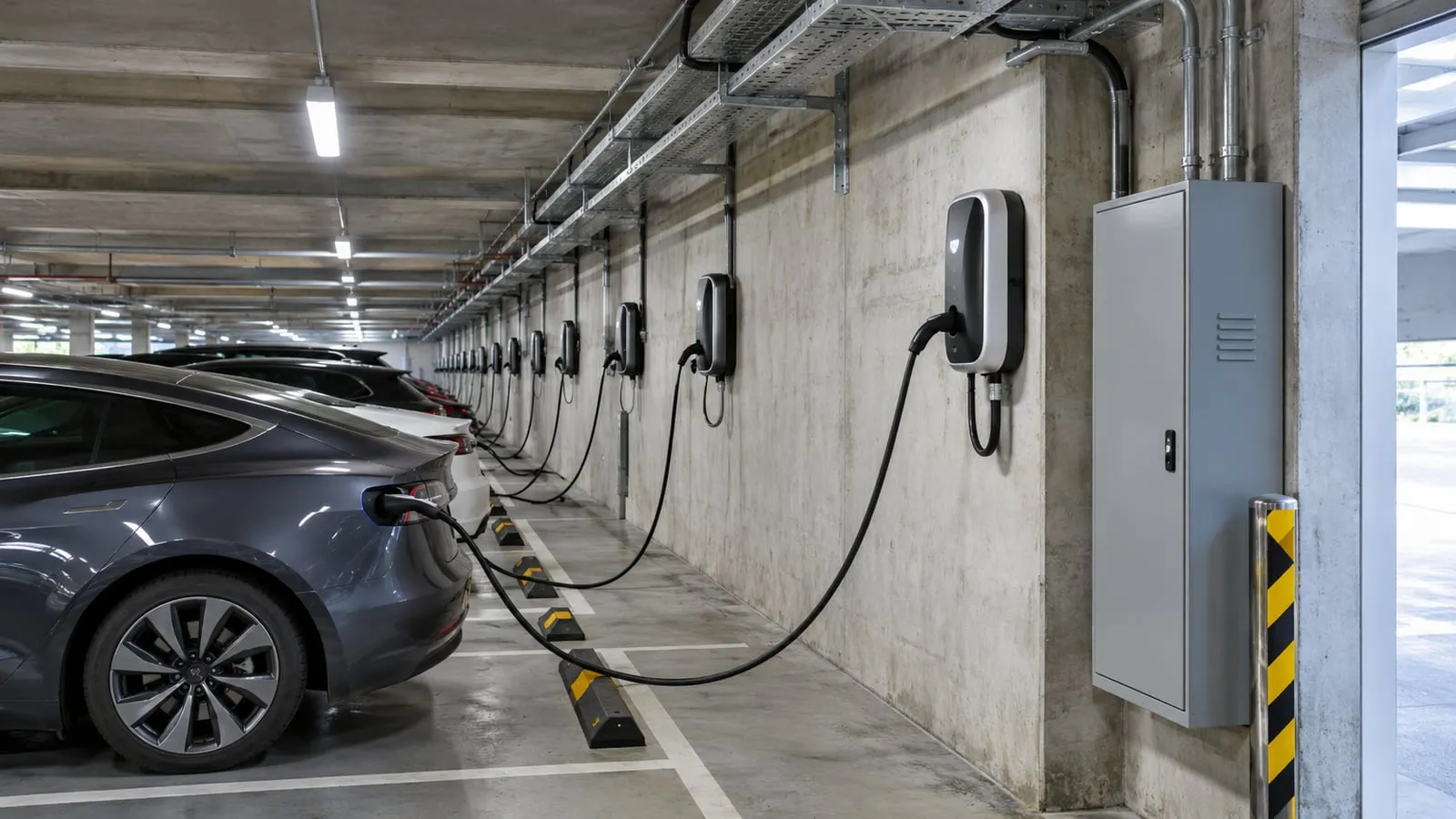
Cars rarely need full power for the whole time they are plugged in. A car parked overnight for eight hours needs about 30 kWh — that is under 4 kW on average, not 11 or 22 kW. If all chargers ran at full power at once, the supply would have to be huge; if they share, it can be small.
The three levels
| Level | How it works | Best for |
|---|---|---|
| Static | Fixed limit per charger or group, set in the charger or back end | Simple sites, fixed loads |
| Dynamic (building) | A meter or CT on the main supply measures the building load; chargers get the rest | Apartment buildings, offices, shops |
| Smart (price and priority) | Adds priority, departure time, tariffs, solar surplus | Fleets, large sites, sites with time-of-use tariffs |
Sizing example
A residential car park with 20 chargers of 11 kW (three-phase):
| Item | Value |
|---|---|
| Full demand | 20 × 11 kW = 220 kW (about 318 A at 400 V) |
| Available for charging after building load | 125 A at 400 V, about 86 kW |
| Average per charger when all are used | 86 ÷ 20 ≈ 4.3 kW |
| Energy per car over 8 hours | 4.3 × 8 ≈ 34 kWh |
| Result | Most overnight charging needs are met; a supply upgrade from 318 A to 125 A is avoided |
If few cars plug in at the same time, each gets more power. If you want faster daytime charging, add a second pool or a DC charger.
How the control works
- A meter or current transformer (CT) measures the building’s load on the main supply.
- A controller — in a charger, on the site or in the cloud — calculates the spare capacity and divides it among active chargers.
- The controller sends limits to the chargers. With OCPP this is done by smart-charging profiles, so any OCPP charger can take part.
- The charger sets the pilot signal to the car, which then reduces the current.
OCPP smart charging is available in 1.6J and 2.0.1; 2.0.1 has richer profiles. See OCPP 1.6J vs 2.0.1.
What to check
| Question | Why |
|---|---|
| What happens if communication is lost? | The charger should fall back to a safe current (fail-safe), not full power |
| Is it phase aware? | Single-phase cars on one phase can overload it; the system must balance |
| Can it set priorities? | Fleets, rental cars or visitors may need preference |
| Does it work with other loads such as heating and lifts? | Needs a meter on the main supply, not only the chargers |
| Is it local or cloud? | Local control keeps working without internet; cloud is easier to manage |
| Does it support minimum current? | Cars stop below 6 A; the system must pause some chargers instead of starving all |
Common mistakes
- Fixing the limit at the breaker size. Keep a margin, since the main breaker must not trip.
- Forgetting the minimum 6 A. If the spare power is only 20 A and ten cars are plugged in, the system must rotate the charging.
- Mixing chargers from different makers without testing the integration.
- No metering on the main supply. Without it the system cannot see the other loads.
VULTAE support
Our smart AC chargers include home dynamic load balancing with a current transformer on the main supply, solar-surplus balancing, and group and power management for multi-charger sites; they connect over OCPP 1.6J / 2.0.1 so that a back end can manage a whole site. For site design, see installation requirements; for apartment buildings, see apartments and condos; for cable sizes, see wire size tables.
Questions buyers ask
- What is dynamic load management for EV chargers?
- A control function that measures the electrical load of the building or site and adjusts the current of each charger so that the total never exceeds the supply limit. When other loads fall, chargers get more current; when they rise, chargers get less.
- What is the difference between static and dynamic load management?
- Static load management sets a fixed maximum for a group of chargers, regardless of what else the building uses. Dynamic load management follows the actual load in real time, so it can use unused capacity safely.
- Do I need a local controller?
- Not always. Small sites can use chargers that talk to each other directly. Larger sites use a local controller or a cloud back end that sends OCPP smart charging profiles. For sites that must stay safe when the internet is down, a local controller or a charger with a fail-safe limit is advisable.
- How many chargers can I add on a limited supply?
- There is no fixed number. Divide the available power by the energy each car needs per day and the hours available. In a residential car park with overnight charging, an average of 3–4 kW per charger is often enough.
References
- [1]Open Charge Point Protocol (OCPP). Open Charge Alliance.
- [2]IEC 60364-7-722:2018 — supplies for electric vehicles. International Electrotechnical Commission.
- [3]Regulations: electric vehicle smart charge points. GOV.UK.