Distributors & Installers
Training Installers on a New EV Charger Brand
A training plan for installers who fit your EV charger brand: syllabus, hands-on session, commissioning record, tools, certification and how to keep quality up.
- Prepared by
- VULTAE Engineering Team
- Published
- Reading time
- 2 min
- Sources
- —
Key takeaways
- 1Installers decide whether your brand is easy or painful to recommend. A short, practical course on your own chargers reduces faulty installs, warranty claims and call-backs more than any manual.
- 2Cover the product, the electrical rules in the market, mounting and wiring, app and back-end set-up, commissioning tests and fault finding. Finish with a hands-on session and a short test.
- 3Keep a record of who is trained, give them a commissioning checklist and a direct line for support. Refresh the training when the hardware or firmware changes.
Contents
Short answer: run a short, hands-on course on your chargers, give every installer a commissioning checklist and support contact, and track who is trained. Refresh when the product changes.
Syllabus
| Module | Content | Time |
|---|---|---|
| 1. Product range | Models, power, versions, options, what suits which site | 30 min |
| 2. Electrical rules | Local standards, supply types, protection; see installation requirements | 45 min |
| 3. Cable and breaker sizing | Tables and the calculator; see wire size | 30 min |
| 4. Mounting | Wall types, posts, positioning; see mounting a wall charger | 30 min |
| 5. Wiring and settings | Terminals, current setting, phases, earthing | 45 min |
| 6. App and back end | Pairing, OCPP, load management, firmware | 45 min |
| 7. Commissioning | Tests, records, handover; see commissioning checklist | 30 min |
| 8. Faults and support | LED codes, common faults; see LED status codes and troubleshooting | 30 min |
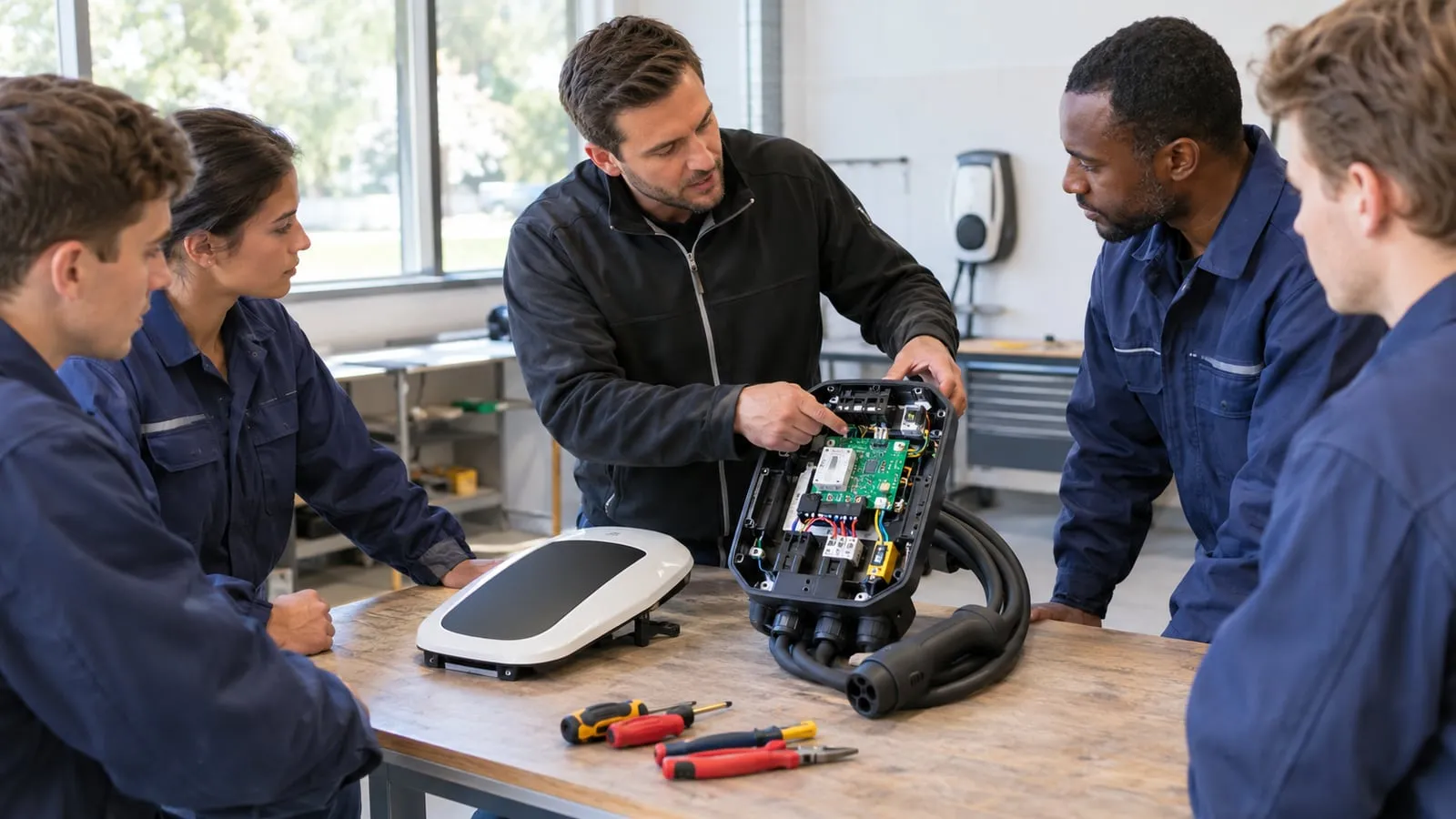
Hands-on session
Give every trainee time on real chargers:
- Open a unit and identify the terminals and the protection devices.
- Set the current limit and phase configuration.
- Mount a unit on a plate and route the cable.
- Connect the charger to the app and a test back end.
- Run the commissioning tests and fill in the record.
- Find a fault the trainer has prepared, such as a loose neutral or a wrong setting.
Materials to prepare
| Item | Purpose |
|---|---|
| Quick-start guide | One page for the van |
| Commissioning checklist | The same on every job |
| Wiring diagrams | By model and supply type |
| Video clips | Short, one topic each |
| Spare parts list | What to carry |
| Support contact and escalation path | Reduces call-backs |
For the support side see warranty and claims and remote diagnostics.
Measure and maintain quality
- Register each installer: name, company, date, models, test result.
- Ask for the commissioning record with each warranty claim.
- Track call-backs per installer and offer a refresher where needed.
- Recognise good work with leads, as in an installer partner programme.
- Update the course when firmware or hardware changes.
Local rules
Electrical work must follow the rules of the country, and in many places only a licensed electrician may connect the charger. The brand course supports that, it does not replace it. See also quote templates for installers.
VULTAE can provide a training outline, wiring diagrams and a commissioning checklist for each model in your range.
Questions buyers ask
- How long should the training be?
- A half day for AC wallboxes, a full day if it includes the app and back end, and more for DC chargers. Short repeatable sessions work better than a long one.
- Should training be certified?
- A brand certificate is useful for your channel and for customers, but it does not replace the local electrical licence an installer needs. Say clearly what the certificate means.
- Can training be done online?
- Theory, videos and a test can be online. Hands-on mounting, wiring and commissioning are best done on real equipment, in person or with a kit.