Certification & Compliance
EV Charger EMC Testing: Why Chargers Fail and How to Pass
What EMC testing for EV chargers covers (emissions and immunity), why chargers fail, how to prepare a sample and what to check in the test report.
- Prepared by
- VULTAE Engineering Team
- Published
- Reading time
- 2 min
- Sources
- —
Key takeaways
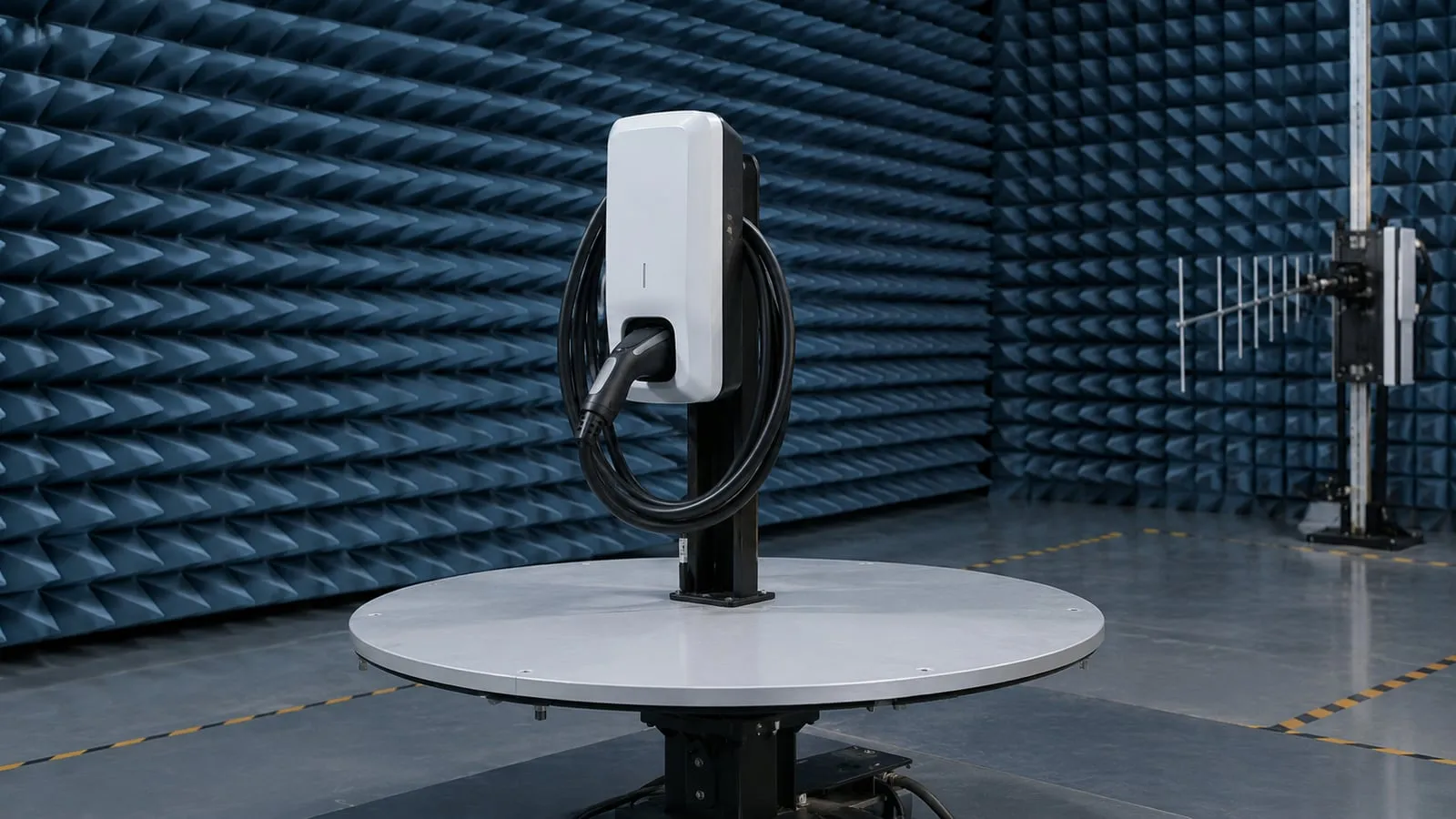
- 1EMC testing checks two things: that the charger does not emit too much electrical noise and that it keeps working when it is exposed to noise, surges and static discharge. The relevant standard family for EV supply equipment is IEC 61851-21-2, with the generic EMC standards referenced from it.
- 2Chargers fail for ordinary reasons: switching power stages without enough filtering, cables that act as antennas, poor earthing and enclosure seams. Most fixes are design changes such as filters, ferrites and layout, not luck.
- 3When you buy, ask for the EMC test report for the exact model and version, check the standards and limits it lists and compare the tested configuration with the one you will ship.
Contents
Short answer: EMC testing shows the charger does not disturb other equipment and keeps working when disturbed. Ask for the report for your exact model, check the standards and limits and see that the tested set-up matches what you buy.
What EMC testing covers
| Group | Question | Examples of tests |
|---|---|---|
| Emissions | How much noise does the charger produce? | Conducted emissions on the mains, radiated emissions, harmonics and flicker |
| Immunity | Does it keep working when disturbed? | Electrostatic discharge, radiated fields, fast bursts, surges, conducted disturbances, voltage dips |
| Functional behaviour | Does it stay safe during a disturbance? | No unexpected start, stop or loss of safety function |
For off-board DC chargers the main product standard is IEC 61851-21-2; for on-board chargers and others different parts apply. See the IEC 61851 charging modes for the wider family.
Why chargers fail
- Switching noise from the power stage not filtered enough at the mains input.
- Cables as antennas: long output and communication cables carry noise out of the enclosure.
- Earthing and bonding: poor connection of the enclosure and shield.
- Seams and openings in the enclosure, for displays, vents and cable entries.
- Sensitive control electronics: microcontrollers resetting on a burst or a surge.
- Surge protection missing or badly placed; see surge and lightning protection.
How to prepare a sample
| Step | Detail |
|---|---|
| Choose the configuration | Highest power, longest cable, all options such as display and 4G |
| Pre-scan | Check emissions in-house before the lab slot |
| Provide a load | A battery simulator or load bank, so the charger works at full power |
| Define pass criteria | What counts as normal operation during each test |
| Record the set-up | Photos, cable lengths, grounding and layout |
Reading a test report
- Model and version match the product you are buying.
- Standards listed, including edition and year.
- Test set-up photos and description.
- Results against limits, with the margin.
- Performance criteria and any observations.
- Laboratory accredited for these tests; see how to check a certificate.
Pair this with the factory test report and the sample testing list.
What to do when a test fails
- Find the cause with a pre-compliance scan, not guesses.
- Fix with design changes: input filter, ferrites, layout, shielding, cable routing.
- Re-test the changed design and record the revision.
- Update the technical file and the model documentation.
Buyer checklist
| Question | Good answer |
|---|---|
| Is there an EMC report for my model? | Yes, with the version and date |
| Which standards and editions? | Listed and current |
| Which configuration was tested? | The one I will receive |
| What happens when design changes? | A revision and a re-test process |
VULTAE can supply the compliance documents for your exact model on request; see certifications.
Questions buyers ask
- What is the difference between emissions and immunity?
- Emissions measures the noise the charger sends out, through the cable and through the air. Immunity measures whether the charger keeps working when it is hit by interference, surges, bursts or static.
- Is EMC testing part of CE marking?
- For the EU, EMC is one of the requirements behind the CE marking of EV chargers, so the technical file should include EMC evidence. Check the current directives and standards with your test house.
- What if I change the design after testing?
- A change to the power stage, filters, enclosure or cables can affect EMC. Agree a change process with the supplier and re-test where the change could matter.