Installation & Power
Surge and Lightning Protection for EV Chargers
How surge protective devices (SPD types 1, 2 and 3) and lightning protection protect EV chargers, where to fit them and what to ask the supplier.
- Prepared by
- VULTAE Engineering Team
- Published
- Reading time
- 3 min
- Sources
- 3 references
Key takeaways
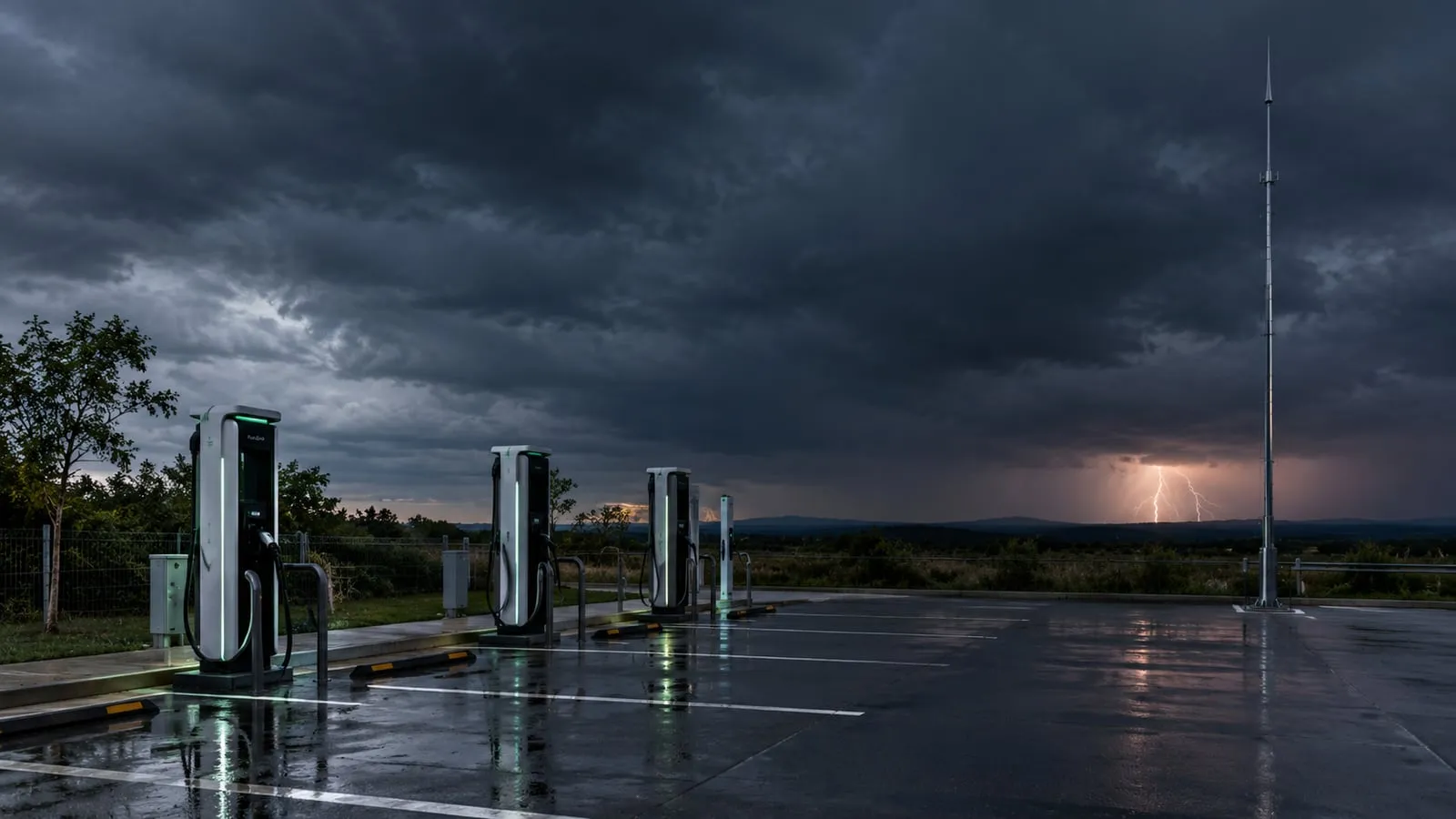
- 1Outdoor chargers are exposed: long cables, open car parks and electronics that dislike voltage spikes. A surge protective device (SPD) in the board plus protection inside the charger is a low-cost insurance against failed power supplies and boards.
- 2SPD types: Type 1 handles direct lightning current at the building entrance; Type 2 handles induced surges on the distribution board; Type 3 protects sensitive equipment locally. Most charger sites need Type 2 at least, and Type 1 + 2 where a lightning protection system is present or the risk is high.
- 3A surge device only works with good earthing. Short leads, low-resistance earth and bonding of all metal parts matter more than the brand.
- 4Communication and data lines (Ethernet, antenna) also need protection if they run outdoors over long distances.
Contents
Short answer: a surge protective device (SPD) in the supply board and surge protection inside the charger are cheap insurance for an outdoor site. Use Type 2 SPDs at least, Type 1 + 2 where lightning risk is high or a lightning protection system exists, and get the earthing right — a surge device with poor earthing does little.
What causes damage
| Source | How it reaches the charger | Typical damage |
|---|---|---|
| Direct lightning strike | Current into the structure or a nearby pole | Burned power modules, destroyed boards |
| Induced surge from nearby strike | Voltage spike on supply and data cables | Failed power supply, communication board |
| Switching surges | Utility or large loads switching | Gradual wear, random faults |
| Ground potential rise | Earth voltage difference between charger and communication line | Damaged network port |
SPD types
| Type | Tested for | Where | Notes |
|---|---|---|---|
| Type 1 | Direct lightning current (10/350 µs wave) | Main entrance, service cabinet | Needed if there is an external lightning protection system or overhead supply with high risk |
| Type 2 | Induced surges (8/20 µs wave) | Main and sub-distribution boards | Normal choice for most sites |
| Type 3 | Small surges, fine protection | Near the equipment | Complements types 1 and 2 |
| Combined 1+2 | Both | Main board | Saves space |
Choose the SPD to match the supply system (TN, TT) and the voltage, with a rated voltage protection level (Up) low enough for the equipment, and a backup fuse as the manufacturer requires.
Where to put protection at a charger site
- Main board: Type 2 (or 1+2) SPD.
- Charger feeder board: SPD close to the charger, within about 10 m of cable; if farther, add a second SPD.
- Inside the charger: built-in surge protection (check the data sheet).
- Data lines: Ethernet and antenna cable surge protectors if the lines run outdoors between buildings.
- Metal structures: bonding of canopies, bollards and metal poles to the earth system.
Earthing is half of the job
A surge device diverts the surge to earth. If the earth path is long or high in resistance, the voltage on the equipment still rises. Keep SPD leads short and straight, bond all metal parts, and measure the earth resistance — see earthing systems.
Lightning protection systems
A lightning protection system (LPS) with air terminals and down conductors, designed under IEC 62305, can protect a canopy or a building. It is not needed at every site. An LPS raises the need for Type 1 SPDs because part of the lightning current can enter the electrical system. For stand-alone chargers on open ground, a risk assessment decides.
Questions for the supplier
| Question | Why |
|---|---|
| What surge protection is built into the charger? | Defines what you add upstream |
| What SPD type and rating does the manual require? | Warranty conditions |
| Is communication equipment protected? | Data ports are often the weak spot |
| What is the tested impulse withstand voltage? | Compare with the site risk |
| Do you provide a wiring diagram with SPD positions? | Faster, correct installation |
Maintenance
SPDs wear out. Many have a status indicator (green/red); check it during maintenance and after a storm. See the maintenance checklist.
VULTAE chargers
Our AC and DC chargers include surge protection as standard, alongside over- and under-voltage protection. For outdoor sites we recommend adding an SPD in the supply board according to local code. The installation requirements guide lists the typical protection elements, and the DC charger installation article covers the civil side.
Questions buyers ask
- Do EV chargers need surge protection?
- Many installation codes require or recommend it, and most manufacturers include basic surge protection in the charger. For outdoor chargers, additional SPDs in the supply board are good practice, especially in regions with frequent thunderstorms or long overhead lines.
- What is the difference between SPD Type 1, 2 and 3?
- Type 1 is tested for direct lightning current and installed at the service entrance. Type 2 is tested for induced surges and installed on the main or sub-distribution board. Type 3 is a small device near the equipment for fine protection.
- Does a lightning rod protect an EV charging site?
- A lightning protection system can protect the structure and the area nearby, and it should be designed to the lightning protection standard (IEC 62305). It does not replace SPDs, which deal with surges travelling along the cables.
- Is the charger covered by warranty if lightning damages it?
- Warranty terms usually exclude lightning and overvoltage damage unless the installation has the protection the manufacturer requires. Check the warranty text and keep records of the protection installed.
References
- [1]IEC 60364-7-722:2018 — supplies for electric vehicles. International Electrotechnical Commission.
- [2]IEC 61851-1:2017 — general requirements. International Electrotechnical Commission.
- [3]NFPA 70 (National Electrical Code). NFPA.