Sourcing from China
EV Charger Samples: What to Test Before a Bulk Order
A sample test plan for AC wallboxes and DC fast chargers: safety, protection, charging with real cars, metering, OCPP with your back end, heat run, packaging.
- Prepared by
- VULTAE Engineering Team
- Published
- Reading time
- 4 min
- Sources
- 3 references
Key takeaways
- 1A sample is your only chance to find problems before they are multiplied by a container. Test it the way it will be used: your supply, your vehicles, your back end, your climate.
- 2Cover seven areas: inspection and documents, electrical safety and protection, charging with real vehicles, metering accuracy, OCPP integration, a full-load heat run, and packaging.
- 3Write the pass criteria before the sample arrives and record serial numbers, firmware versions and results — the same record becomes the acceptance standard for the bulk order.
- 4Most problems found in sample tests are software: OCPP messages, meter values, reconnect behaviour after a network drop. Test these with your own CPMS, not the supplier’s demo server.
Contents
Short answer: before a bulk order, test the sample in seven areas — inspection and documents, electrical safety and protection, charging with real vehicles, metering, OCPP integration with your back end, a full-load heat run, and packaging. Write the pass criteria first, record serial numbers and firmware versions, and keep one unit as the reference for the bulk order. Most problems surface in software and vehicle compatibility, not in the hardware you can see.
Before the sample arrives
- Agree the configuration in writing: model, power, connector, cable length, meter, RFID, connectivity, OCPP version, firmware version. A sample built differently from the bulk order proves nothing.
- Ask for the documents that will come with the bulk order: manual, installation guide, wiring diagram, test report for this serial number, certificates for the model.
- Prepare the site: the right supply (single-phase or three-phase, or 480 V for North American DC units), correct protection upstream, network access for OCPP, and the vehicles you will test with.
The test plan
| Area | Test | How | Pass when |
|---|---|---|---|
| Inspection | Visual and labels | Check housing, cable, connector, nameplate, serial and ratings | Matches the agreed configuration and the certificate model |
| Inspection | Documents | Manual, wiring diagram, factory test report for this serial | Complete, in your language, matching the unit |
| Safety | Protective earth continuity | Measure between the earth terminal and exposed metal | Low resistance, consistent with the factory report |
| Safety | Insulation resistance | Insulation tester between live parts and earth | Meets the value in the manufacturer’s test report |
| Protection (AC) | Residual-current trip | RCD tester at rated residual current; DC fault detection at 6 mA if fitted | Trips within the device’s rated time; DC detection operates |
| Protection | Emergency stop and door switch (DC) | Press during a session | Output stops and contactors open immediately |
| Charging | Sessions with real vehicles | 3 or more vehicle models, full sessions | Starts reliably, reaches expected power, stops cleanly |
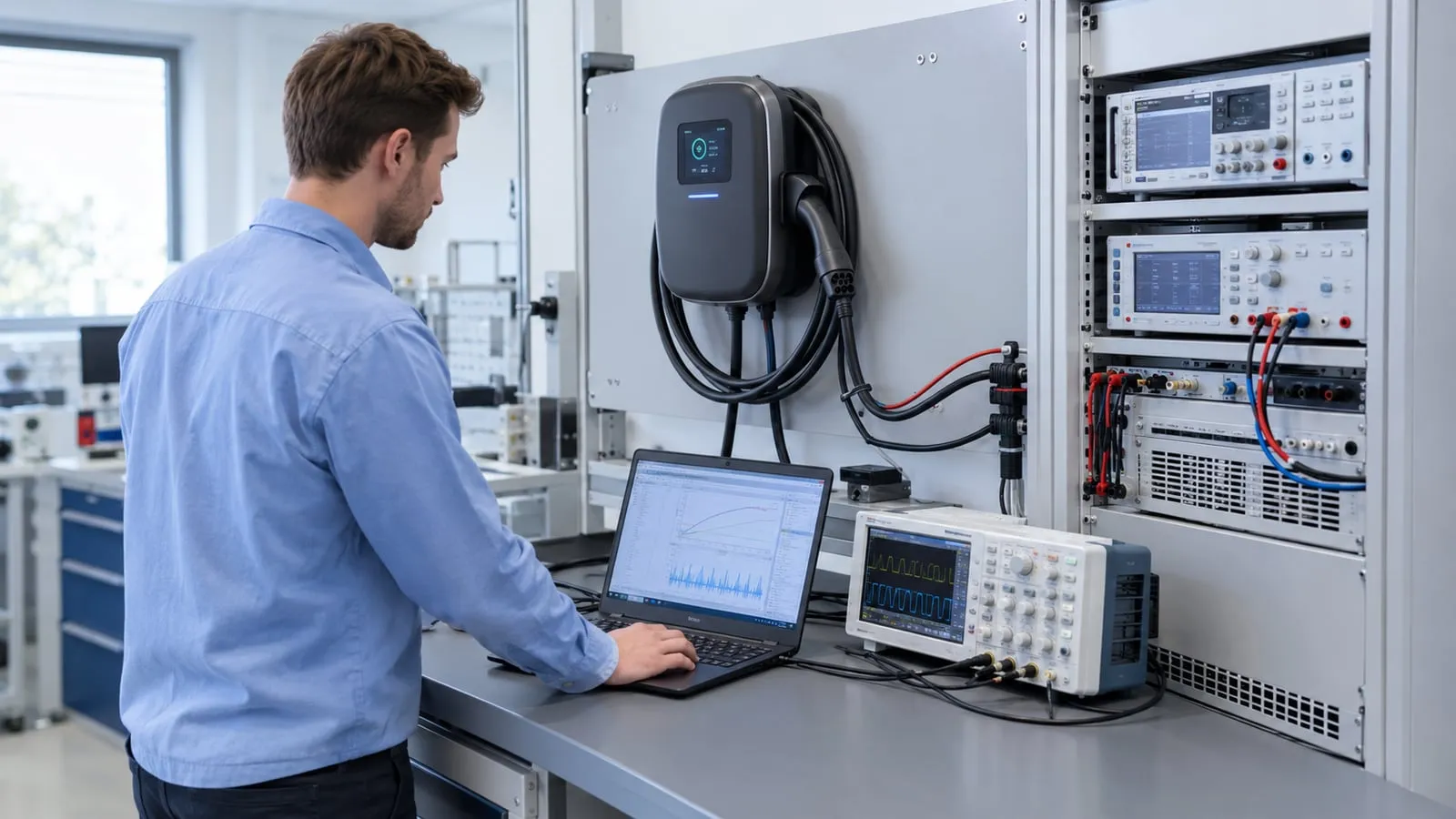
| Charging | Control pilot signal (AC) | Oscilloscope on CP during charging | PWM duty matches the set current (IEC 61851-1) |
| Charging | Power sharing (dual DC) | Connect a second vehicle mid-session | Power reallocates without stopping the first session |
| Metering | Accuracy | Compare with a reference meter over a full session | Within the meter’s accuracy class |
| Software | OCPP integration | Run the functions below with your CPMS | All messages correct, no lost transactions |
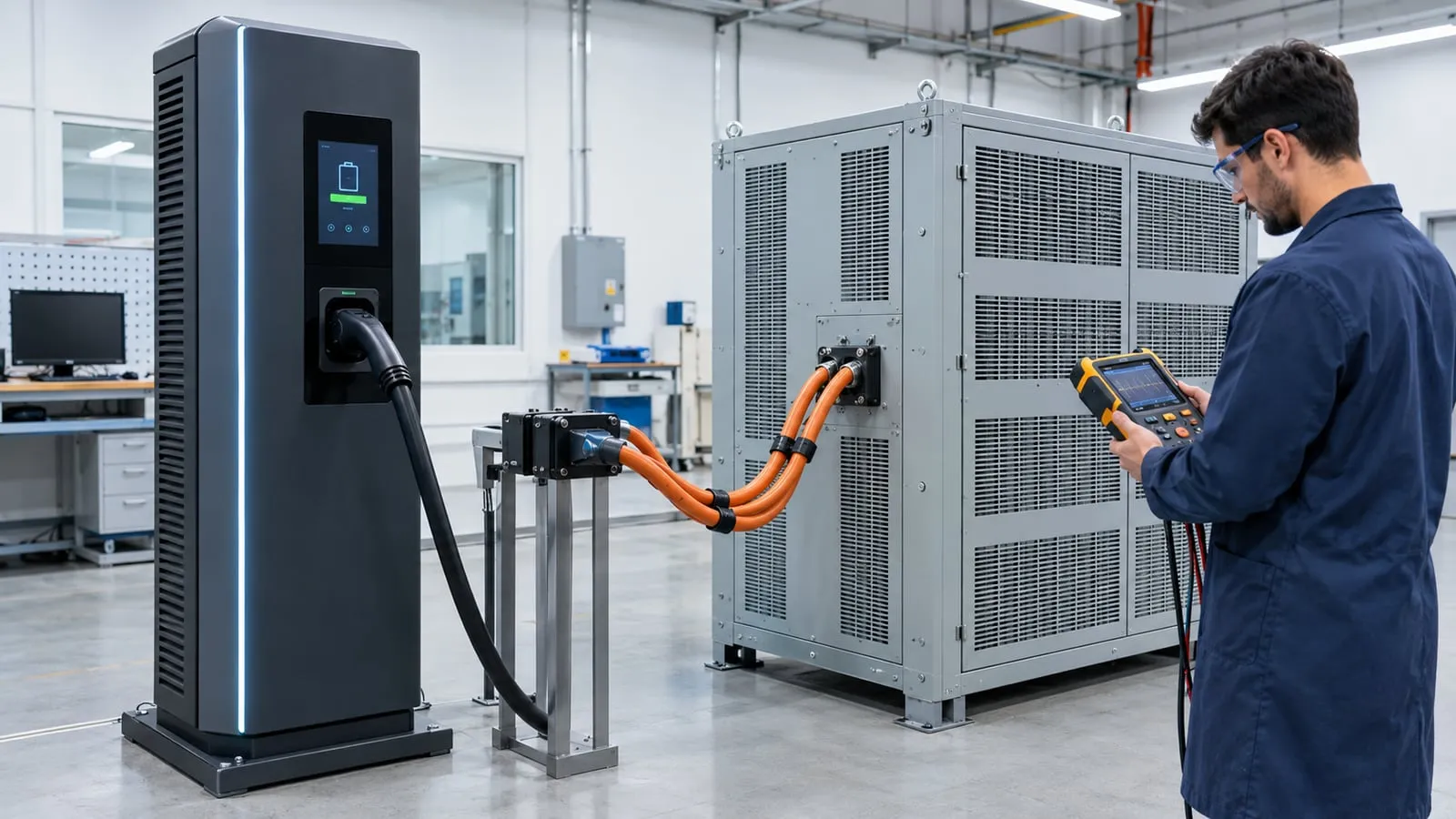
| Endurance | Heat run | Full rated output for 3+ hours at the highest ambient you can achieve | No unplanned derating, no faults, cable and connector temperatures acceptable |
| Endurance | Supply disturbance | Switch supply off and on during charging | Recovers to a safe state and resumes or reports correctly |
| Packaging | Drop and inspection | Check packaging and corner protection on arrival | No damage; packaging suitable for container stacking |
OCPP tests with your own back end
“OCPP supported” on a datasheet tells you little. Connect the sample to the charge point management system you will actually use and run through these messages and situations:
| Function | What to check |
|---|---|
| Boot and heartbeat | The charger registers with the correct vendor, model, serial and firmware |
| Authorisation | RFID cards, app start and (if offered) Plug & Charge are accepted or rejected correctly |
| Transactions | Start and stop events with correct timestamps and meter readings |
| Meter values | Energy, power and current reported at the configured interval |
| Remote commands | Remote start, remote stop, reset, unlock connector |
| Status notifications | Available, charging, faulted states reported as they happen |
| Smart charging | Charging profiles from the CPMS change the charging current |
| Offline behaviour | After a network drop, sessions continue as configured and stored data is sent on reconnect |
| Firmware update | An update pushed from your server installs and the charger reboots cleanly |
DC-specific checks
- Vehicle communication: DC charging relies on digital communication between charger and car. Test with several vehicle models and record any failed handshakes with the vehicle model and software version.
- Current per connector: confirm the maximum current your cable and connector deliver — at 200 A a 400 V-class car reaches about 80 kW (see our 120 kW charger guide).
- Derating: run at full output in the warmest conditions available and note when and how the charger reduces power.
- Noise and airflow: measure noise near the charger and check that filters can be reached for cleaning.
Record everything
Use one record per sample: serial number, firmware version, configuration, date, tester, each test with the measured value and pass / fail, and photos. Send failures to the supplier with logs. After fixes, retest the failed items on the same unit.
That record then becomes part of the purchase contract: the bulk order must match the approved sample’s configuration and firmware, and pass the same tests at pre-shipment inspection.
Samples from VULTAE
Ask us for samples in the configuration you will order, together with the factory test report for each serial number, and tell us which CPMS you use so the OCPP set-up can be prepared. See also our guides on choosing a manufacturer and reading a factory test report.
Questions buyers ask
- How many EV charger samples should I order?
- At least two of each model: one to test hard (protection trips, heat run, faults) and one to keep as the reference unit for the bulk order. If you are comparing suppliers, order the same configuration from each.
- How long does EV charger sample testing take?
- A focused test of an AC wallbox takes a few days once installed; a DC charger with vehicle tests, a heat run and OCPP integration usually takes one to two weeks. Integration issues found during testing can add time while the supplier updates firmware.
- Which vehicles should I test with?
- The models most common in your market, including at least one older model and one recent model, and for DC chargers both a 400 V-class and an 800 V-class car if you can. Communication compatibility problems tend to appear with specific vehicle models.
- What OCPP functions should I test?
- Boot and heartbeat, authorisation by RFID or app, start and stop of a transaction, meter values during charging, remote start and stop, status notifications, reconnecting and sending stored data after a network drop, and a firmware update from your server.
- Should I test samples myself or use a lab?
- Functional, vehicle and OCPP tests are best done by your own team at a pilot site. Safety and EMC compliance should be covered by accredited lab reports from the manufacturer; commission a third-party lab only if you need independent confirmation for a tender or a regulator.
References
- [1]IEC 61851-1:2017 — Electric vehicle conductive charging system, general requirements. International Electrotechnical Commission.
- [2]IEC 61851-23:2023 — DC electric vehicle supply equipment. International Electrotechnical Commission.
- [3]OCPP — Open Charge Point Protocol. Open Charge Alliance.