OEM & Private Label
Packaging, Labels and Manuals for Private-Label EV Chargers
What packaging, rating labels and manuals a private-label charger needs: artwork, languages, marks, barcodes, approval steps and the mistakes to avoid.
- Prepared by
- VULTAE Engineering Team
- Published
- Reading time
- 2 min
- Sources
- —
Key takeaways
- 1Packaging, rating labels and manuals carry your brand and your legal information. They are part of the product, so plan them together with the charger and approve proofs before production.
- 2The rating label must match the certificate and the model name; the manual must match the firmware, features and local requirements. Changes to labels can affect certification, so check with the certification body.
- 3Most problems come from late artwork, wrong languages, missing marks and unchecked proofs. A simple approval workflow avoids them.
Contents
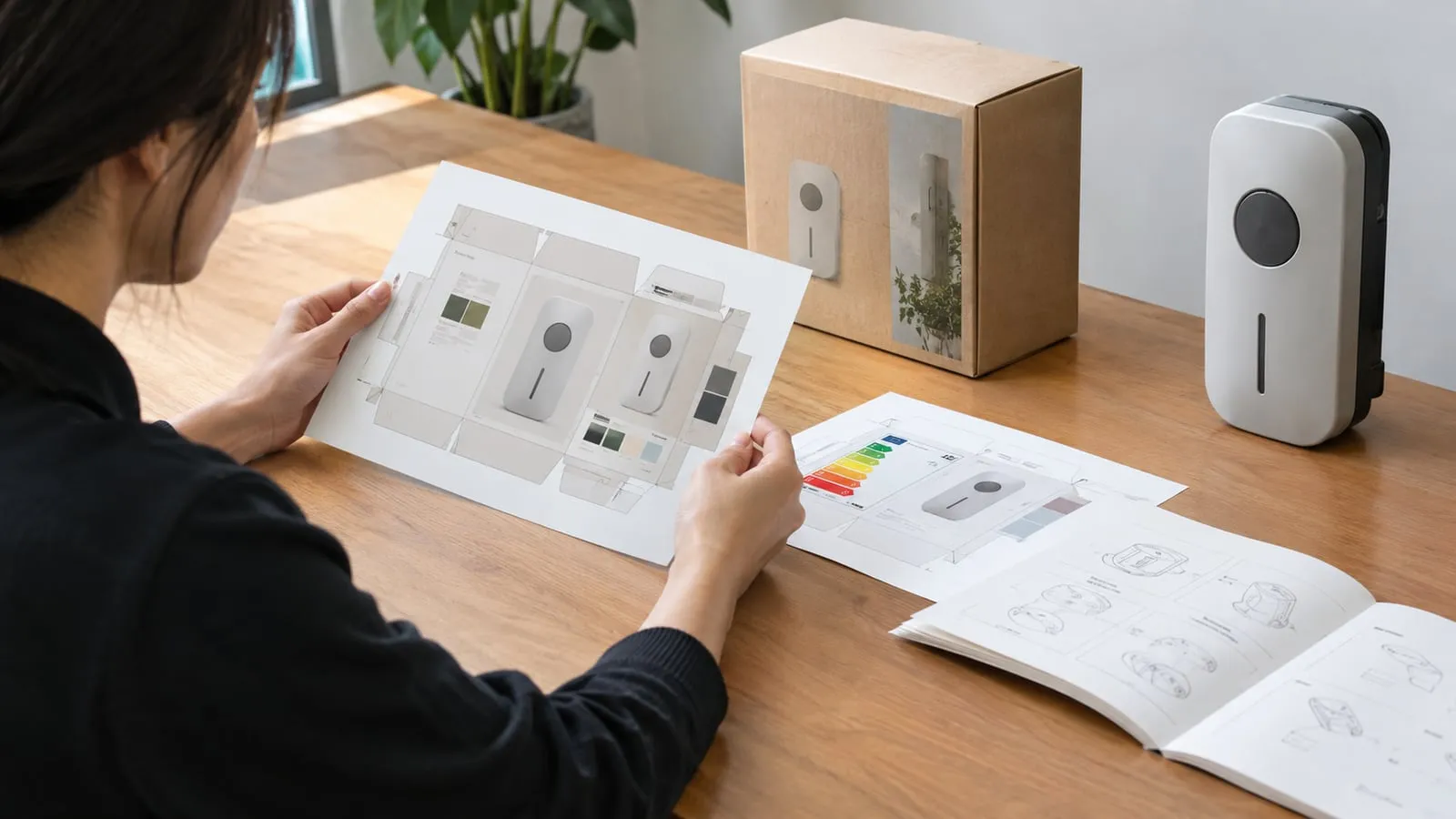
Short answer: plan cartons, rating labels and manuals together with the charger, make sure the label matches the certificate, have a native speaker review translated text and approve a proof before production.
What a private-label charger needs on paper and print
| Item | What it must contain | Check against |
|---|---|---|
| Carton | Brand, model, key ratings, barcode, handling marks, language | Order and logistics needs |
| Rating label on the charger | Brand and model, voltage, current, power, frequency, IP/IK, serial number, marks | Certificate and test report |
| Quick guide | First installation steps, safety summary, QR to full manual | Manual |
| Manual | Safety, installation, commissioning, operation, maintenance, troubleshooting, technical data, legal text | Firmware and hardware version |
| Warranty card or terms | Your warranty terms and contact | Contract with the customer |
| Declarations and marks | CE, UKCA, TÜV, ETL and others as applicable to the model | Certificates held for that model |
The label is a legal and technical document
The rating label is read by inspectors, electricians and customers. It must show the same model name and ratings as the certificate and test report. If your brand uses a new model name, agree with the supplier and the certification body how the certificate will cover it; see certification after rebranding and how to verify a certificate.
Artwork and approval workflow
- Brand pack: logo files, colours, fonts, clear space, languages.
- Templates: the factory sends carton and label templates with the required marks and space.
- Draft proof: you review text, ratings, barcodes and marks.
- Technical check: an engineer compares the label with the certificate and the manual with the firmware.
- Sign-off: one named person approves the final proof in writing.
- First article: check the first printed cartons and labels before the whole batch is packed.
Manuals: content and languages
A good manual covers safety, installation, commissioning, operation, maintenance and troubleshooting — see the manual checklist. For private label:
- Replace the factory’s name and contact details with yours.
- Match the model names, options and firmware features to what you sell.
- Provide translations for every market. Have a native speaker with technical knowledge review safety text.
- Version the manual: each version should link to a firmware and hardware revision.
Barcodes, serial numbers and traceability
Agree the barcode format, how serial numbers are generated and how they are printed on the label and the carton. Serial numbers are the key for warranty claims and for tracing a batch if there is a problem; see warranty claims.
Common mistakes
| Mistake | Result |
|---|---|
| Artwork sent late | Production waits |
| Label ratings differ from certificate | Customs or inspection problems |
| Unchecked translations | Unsafe or confusing instructions |
| Wrong power plug or market marks | Product cannot be sold in the target market |
| No version control for the manual | Mismatch with firmware |
| Packaging not tested | Damage in transit; see export packaging |
VULTAE can customise shell colour, logo, screen, app and packaging; see the OEM / ODM page and the private-label guide.
Questions buyers ask
- Who supplies the artwork for private-label packaging?
- You provide logos, colours and brand guidelines; the factory prepares templates and proofs. Approve a printed or digital proof for the carton, the rating label and the manual before production.
- Do changes to labels affect certification?
- They can. Certification bodies often review markings and instructions. When you rebrand or change text, ask the body what must be re-checked; see certification after rebranding.
- How many languages should the manual have?
- The languages your market and customers need, and any that local rules require for safety information. Have a native speaker check translations of safety text.