Sites & Applications
EV Charging Safety Signage and Floor Markings
Which signs and floor markings an EV charging site needs: bay identification, connector and power information, price and payment, emergency stop and contacts.
- Prepared by
- VULTAE Engineering Team
- Published
- Reading time
- 2 min
- Sources
- —
Key takeaways
- 1Good signs do three jobs: they help a driver find the site, tell them how to use the charger and warn about hazards. A site with clear signage has fewer faults reported by confused users and fewer blocked bays.
- 2Cover the basics at every site: a sign for the road, bay marking and a sign at each bay with the rules, the price and payment method, the connector and power, the emergency contact and the emergency-stop location.
- 3Signage rules differ by country and by site type. Use the local standard or authority guidance where it exists, and keep the language, symbols and units simple.
Contents
Short answer: provide road signs, bay markings and a bay sign with rules, price and payment, connector and power, emergency contact and the emergency-stop location. Use the local standard where there is one.
Signs and where they go
| Sign | Where | Purpose |
|---|---|---|
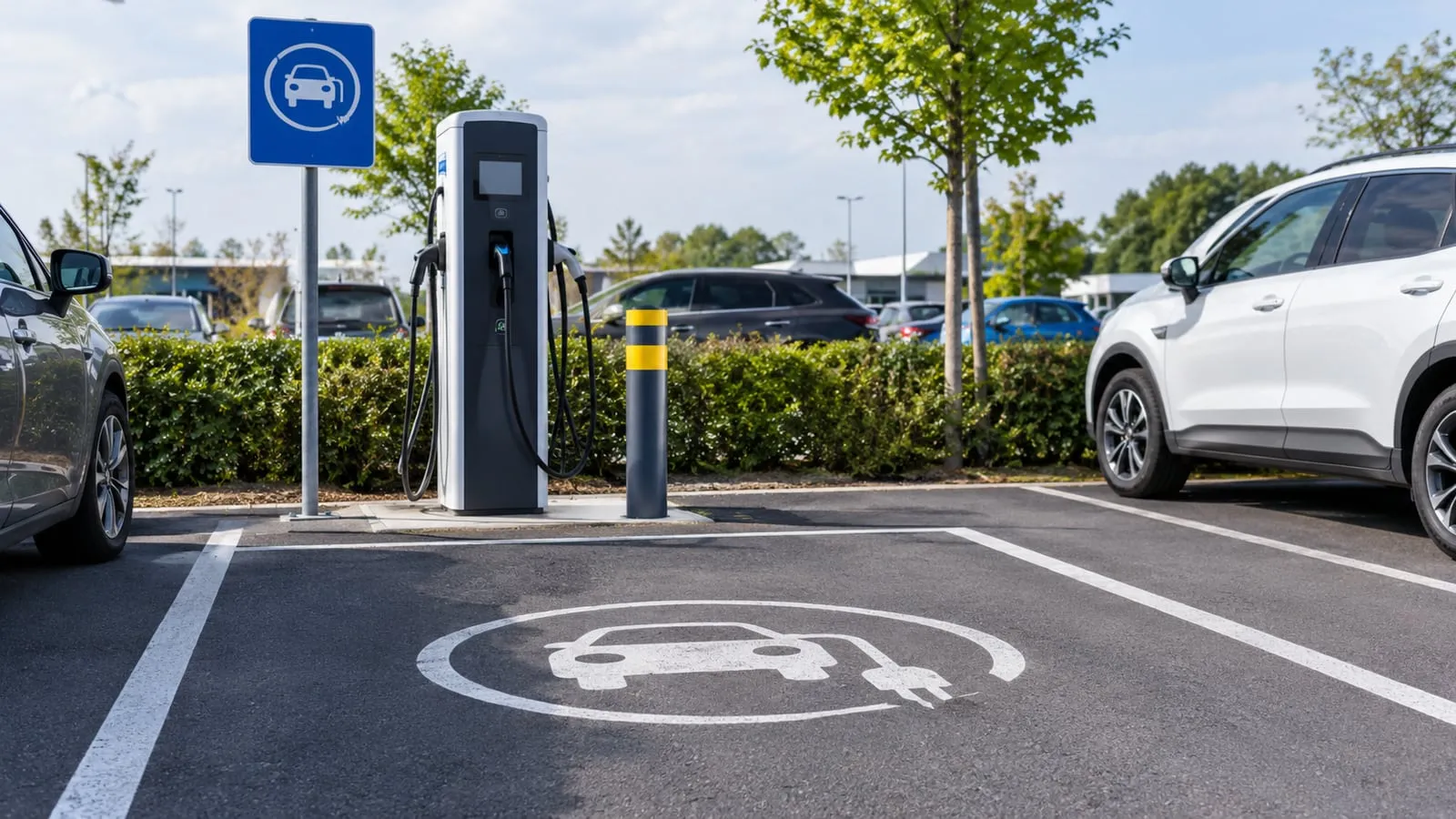
| Road or entrance sign | At the road and the car park entrance | Helps drivers find the site |
| Direction signs | Inside the car park | Leads to the charging area |
| Bay marking | On the floor | Shows bays reserved for charging |
| Bay sign | At each bay or pair of bays | Rules, price, contact |
| Charger information | On the charger | Connector types, power, how to start |
| Safety sign | Near the charger | Warnings and emergency instructions |
| Accessible bay sign | Accessible bays | Clear identification |
For layout see bay layout, signage and bollards and accessible charging bays.
What the bay sign should say
- Reserved for charging electric vehicles with a simple symbol.
- Maximum stay or idle fee, if any; see idle fees.
- Price or where to see it, and how to pay; see payment options.
- Connector and power of the charger.
- A helpline number for faults.
- Operator name and a site ID.
Safety information
| Item | Content |
|---|---|
| Emergency stop | Location and how to use it |
| Emergency contacts | Fire, ambulance and operator |
| Electrical warnings | On the charger and any cabinet |
| Garage rules | Where relevant; see parking garage fire safety |
| Cable hazard | Keep cables off walkways |
Floor markings
- Use a colour and symbol that is consistent across the site.
- Mark the bay length and width and the position of the charger.
- Keep markings visible in rain and at night with good lighting.
- Mark pedestrian routes and keep them clear of cables.
Good practice
- Keep text short and put key numbers in large print.
- Use symbols and units that are easy to understand.
- Check signs regularly for damage and fading.
- Match signs to local language and to the visitors’ languages.
- Update price and contact details when they change.
Plan it early
Include signs in the site plan, the budget and the commissioning list; see the commissioning checklist. VULTAE can provide product information labels and mounts for the charger side.
Questions buyers ask
- Are there mandatory signs?
- Some countries and regions set requirements for public charging points and for fire and electrical safety. Check the local rules and the requirements of the site owner and the insurer.
- What should the bay sign say?
- That the bay is for charging electric vehicles only, the maximum stay if there is one, the price or where to see it and a contact number. Keep the wording short.
- Should signs be in more than one language?
- Yes, where visitors speak several languages. Use symbols and numbers that cross languages.