Sites & Applications
Accessible EV Charging Bays: Layout and Reach
How to design EV charging bays that wheelchair users and others can use: bay width, level surface, reach heights, cable weight, controls and payment.
- Prepared by
- VULTAE Engineering Team
- Published
- Reading time
- 3 min
- Sources
- 2 references
Key takeaways
- 1An accessible bay needs more width (so that a door or ramp can open fully), a level, firm surface, a clear route to the charger and controls and cable within reach from a seated position.
- 2Typical targets: operable parts and connector holder roughly 0.8–1.2 m above the ground, screens readable from a seat, a light cable that can be handled with one hand, and no kerb between the bay and the charger. Exact figures come from local accessibility rules.
- 3Many countries now set accessibility rules for public chargers; the UK, for example, has published a specification for accessible charge points. Check the rules where you build.
- 4Good accessible design helps everyone: parents with prams, older drivers and users carrying luggage.
Contents
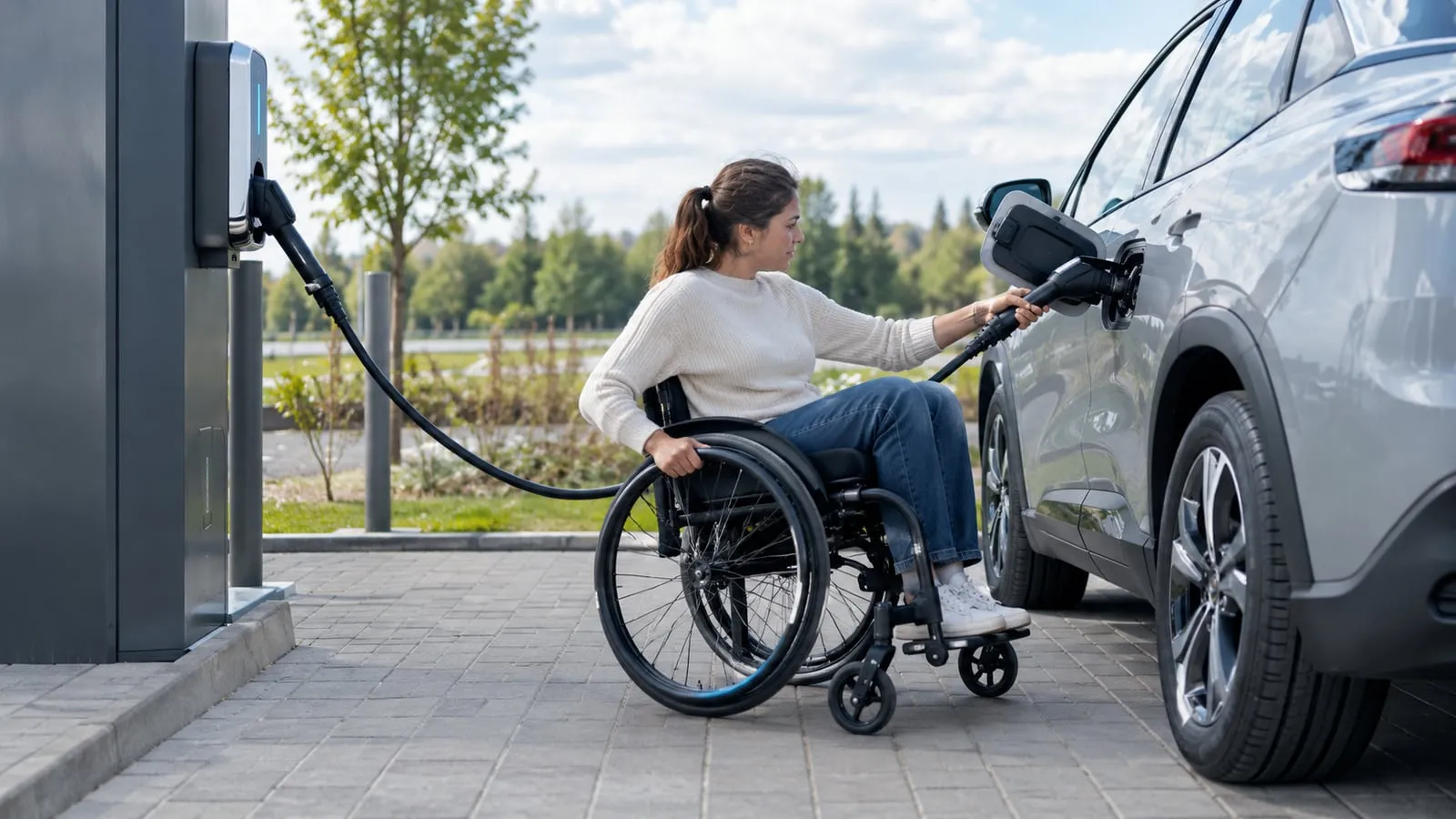
Short answer: an accessible bay needs extra width, a level firm surface, a clear route to the charger, and controls, screen, payment and cable within reach from a seated position — roughly 0.8–1.2 m high. Exact figures come from local rules, so check them before you build. Good design helps everyone.
What to design for
| Element | Aim |
|---|---|
| Bay width | Room for a door, ramp or lift to open and a wheelchair to pass; often an access aisle beside the bay |
| Surface | Level (slight drainage slope only), firm, no loose gravel or deep joints |
| Route | Continuous and step-free from the bay to the charger and the entrance |
| Charger position | Next to the bay, reachable without crossing traffic; no kerb in the way |
| Controls and screen | Within the reach range; readable from a seat; visible in sunlight |
| Connector holder | In the reach range; cable not heavy |
| Payment | Card reader at reach height; alternatives (app, phone support) |
| Signage | Clear, with accessible symbol; instructions in simple language |
| Lighting | Good, even lighting along the route and at the charger |
Reach and handling
Seated users can reach comfortably within a band, often between about 0.8 and 1.2 m above ground and not too far forward. The connector must be held in a place that does not require bending down or stretching. A lighter, shorter cable, a retractor or boom and a handle that is easy to grip make a big difference — see cable management.
Bay layout
- Place accessible bays near entrances or lifts, with a short, sheltered route.
- Pair bays with a shared access aisle to save space.
- Leave space on the side where the charge inlet is; vehicle inlets differ, so provide room on both sides or choose the central position of the charger — see bay layout.
- Protect the charger with bollards without blocking the route.
Controls and interface
- Large, high-contrast displays and tactile or large buttons.
- No need for a touch screen alone: offer an app, RFID card or a phone number.
- Audio or simple language instructions help users with visual or cognitive needs.
- Contactless card payment at a suitable height — see payment options.
Rules
Several countries now set accessibility rules for public chargers, for example through national specifications and public charge point regulations. In Great Britain a published specification covers accessible charge points, and public chargers there also fall under the Public Charge Point Regulations 2023. In the EU, AFIR sets common requirements for public chargers; national rules add detail. In the US, accessibility rules under the Americans with Disabilities Act and state requirements apply. Always check the current local rules.
Checklist
- Bay width with access aisle
- Level, firm surface; step-free route
- Charger controls, screen and card reader in reach range
- Connector holder in reach range; light cable
- Payment alternatives
- Lighting and signage
- Bollards that do not block access
- Review with a user group or access consultant
VULTAE accessories
Our accessories range includes payment-terminal holders and stands that can be set at suitable heights, and our dual-port pedestal supports card payment and RFID options. Tell us the accessibility rules of your country so we can check the mounting heights for the model.
Questions buyers ask
- How wide should an accessible EV charging bay be?
- Wide enough for doors, ramps and lifts to open fully and for a wheelchair to pass — often 3.3–3.6 m plus an access aisle, depending on local rules. Check the national standard.
- At what height should the charger controls be?
- Controls, card readers and the connector holder are often specified within about 0.8–1.2 m above ground so that seated users can reach them. Confirm in your local accessibility rules.
- Is a lighter cable available for accessible bays?
- Shorter and lighter cables, retractors or booms make handling easier. Avoid heavy high-current cables at accessible bays unless supported by a boom.
- Do payment and screens need to be accessible?
- Yes: screens should be readable from a seat and in bright sun, controls should be operable with one hand, and there should be alternatives to touch screens such as an app or a phone line.
References
- [1]The Public Charge Point Regulations 2023. legislation.gov.uk.
- [2]Regulation (EU) 2023/1804 — AFIR. EUR-Lex.