Installation & Power
EV Charger Voltage and Frequency by Country: Quick Reference
Typical mains voltage, phases and frequency for EV charger buyers in 30+ markets, with the connector in use and the charger version to order. Verify locally.
- Prepared by
- VULTAE Engineering Team
- Published
- Reading time
- 4 min
- Sources
- 3 references
Key takeaways
- 1Most of the world uses 230/400 V at 50 Hz. North America uses 120/240 V split-phase at 60 Hz (commercial three-phase 208 V or 480 V). Some countries mix systems, such as Japan (50 and 60 Hz), Saudi Arabia and Brazil.
- 2Order the charger version that matches the site’s voltage, phases and frequency. The connector also depends on the market: Type 2 and CCS2 in most of the world, Type 1 / CCS1 / NACS in North America and parts of Latin America and Asia.
- 3The table gives typical values. The real supply at your site can differ (rural areas, older buildings, industrial parks). Measure it, and confirm with the utility.
- 4Check the charger’s input voltage and frequency range in the data sheet, not just the nominal value. A wide range is a safeguard where the supply fluctuates.
Contents
Short answer: most countries use 230 V single-phase / 400 V three-phase at 50 Hz. North America uses 120/240 V split-phase at 60 Hz, with commercial three-phase at 208 V or 480 V. A handful of countries mix systems. Always measure the site supply and confirm it with the utility, then order the charger version that matches.
Reference table (typical values)
| Region / country | Single-phase | Three-phase | Frequency | AC connector | DC connector |
|---|---|---|---|---|---|
| EU, UK | 230 V | 400 V | 50 Hz | Type 2 | CCS2 |
| Turkey, Russia | 230 V | 400 V | 50 Hz | Type 2 | CCS2 (GB/T also seen) |
| USA, Canada | 120/240 V split phase | 208 V or 480 V (commercial) | 60 Hz | Type 1 (J1772), NACS | CCS1, NACS |
| Mexico | 127 V (and 220 V) | 220 V (127/220 V) | 60 Hz | Type 1 | CCS1 |
| Chile, Argentina | 220–230 V | 380–400 V | 50 Hz | Type 2 | CCS2 |
| Colombia | 120 V (and 208/240 V) | 208 V | 60 Hz | Type 1, Type 2 | CCS1, CCS2 |
| Peru | 220 V | 380 V | 60 Hz | Type 2 | CCS2 |
| Brazil | 127 V or 220 V (varies by region) | 220/380 V | 60 Hz | Type 2 | CCS2 |
| China | 220 V | 380 V | 50 Hz | GB/T | GB/T |
| Japan | 100/200 V | 200 V | 50 Hz (east) / 60 Hz (west) | Type 1 | CHAdeMO |
| South Korea | 220 V | 380 V | 60 Hz | Type 1 | CCS1 |
| Taiwan | 110/220 V | 220 V (or 380 V) | 60 Hz | Type 1 | CCS1 |
| India | 230 V | 415 V | 50 Hz | Type 2, Bharat AC | CCS2 |
| Thailand, Vietnam, Malaysia, Indonesia | 220–230 V | 380–400 V | 50 Hz | Type 2 | CCS2 |
| Philippines | 230 V | 400 V | 60 Hz | Type 2 | CCS2 |
| Australia, New Zealand | 230 V | 400 V | 50 Hz | Type 2 | CCS2 |
| UAE, Qatar, Kuwait, Oman, Bahrain | 230 V | 400 V | 50 Hz | Type 2 | CCS2 |
| Saudi Arabia | 127/220 V and 230 V | 220/380 V or 230/400 V | 60 Hz | Type 2 | CCS2 |
| Egypt, Morocco | 220 V | 380 V | 50 Hz | Type 2 | CCS2 |
| South Africa | 230 V | 400 V | 50 Hz | Type 2 | CCS2 |
These are typical figures. Regulations on connectors are changing; the table shows common practice. Check the destination country in our market guides.
What the charger version must match
| Parameter | Why it matters |
|---|---|
| Phases | A three-phase charger on single-phase supply works only if designed for it — see single-phase vs three-phase |
| Voltage and range | Rated input range must cover the real supply, including drops and swells |
| Frequency | 50 Hz-only products fail on 60 Hz supply; look for 50/60 Hz |
| Earthing system | TN, TT or PME — see earthing |
| Connector | The vehicle fleet in the country decides — see connector types |
| Local approval | Many countries need a national certificate — see the certifications page |
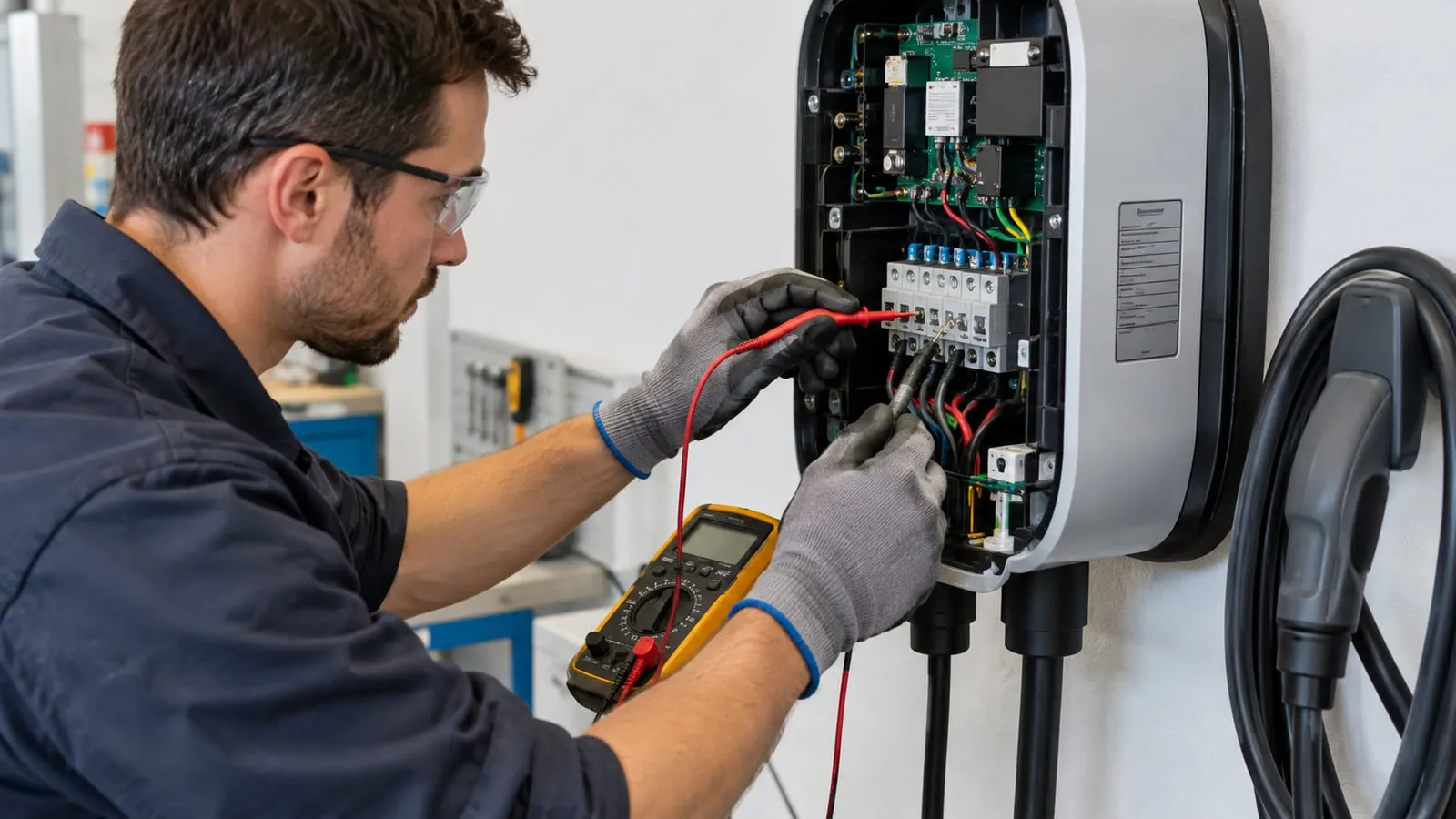
Measure before you order
- Measure voltage on each phase at the intended charger position, at a busy time and at night.
- Note frequency. Where supplies are unstable (generators, weak grids), check frequency and voltage swing.
- Check available current at the board and the main breaker rating.
- Ask the utility about single-phase limits for chargers and about notification or approval rules.
- Photograph the supply label and the board for the supplier.
Special cases
- Japan: 100 V single phase and 200 V; two frequencies; CHAdeMO for DC. Chargers need to match the region.
- Saudi Arabia and the Gulf: mixed systems in older buildings; extreme heat — see hot-climate chargers and the Saudi Arabia guide.
- Brazil and Mexico: 127 V and 220 V mix; confirm voltage by region.
- Weak rural grids: wide-input chargers and load management help.
VULTAE versions
VULTAE chargers are built in an IEC version (230 V single phase / 400 V three phase, Type 2 and CCS2) and a North American version (208–240 V AC for AC chargers, 480 V AC input for DC chargers, Type 1, CCS1 and NACS). Many AC models list 50/60 Hz operation; confirm the exact frequency and input range for the model you order. Tell us the destination and supply, and we will confirm the right version. See the product range.
Questions buyers ask
- What voltage do EV chargers use in Europe?
- Single phase 230 V and three phase 400 V at 50 Hz, with Type 2 connectors for AC and CCS2 for DC. A 22 kW AC charger draws 32 A on each of three phases.
- What voltage do EV chargers use in the United States?
- Homes have 120/240 V split-phase at 60 Hz, and Level 2 chargers use 240 V (up to 48 A, 11.5 kW). Commercial buildings have 208 V or 480 V three phase. The connector is Type 1 (J1772) or NACS for AC, and CCS1 or NACS for DC.
- Can a 50 Hz charger run on 60 Hz?
- Only if the manufacturer lists both frequencies. Many AC chargers support 50/60 Hz; check the data sheet for the exact model, and for DC chargers check the input specification.
- Which countries have both 50 Hz and 60 Hz?
- Japan (50 Hz in the east and 60 Hz in the west) is the best-known example. Parts of Latin America and the Middle East also mix voltages and frequencies, so check the site.
References
- [1]IEC 60364-7-722:2018 — supplies for electric vehicles. International Electrotechnical Commission.
- [2]IEC 61851-1:2017 — general requirements. International Electrotechnical Commission.
- [3]NFPA 70 (National Electrical Code). NFPA.