Sourcing from China
First-Year Spare Parts List for AC and DC Chargers
Which spare parts to stock for AC and DC chargers in year one, how to size the stock from your installed base and lead times, and how to organise it.
- Prepared by
- VULTAE Engineering Team
- Published
- Reading time
- 4 min
- Sources
- 2 references
Key takeaways
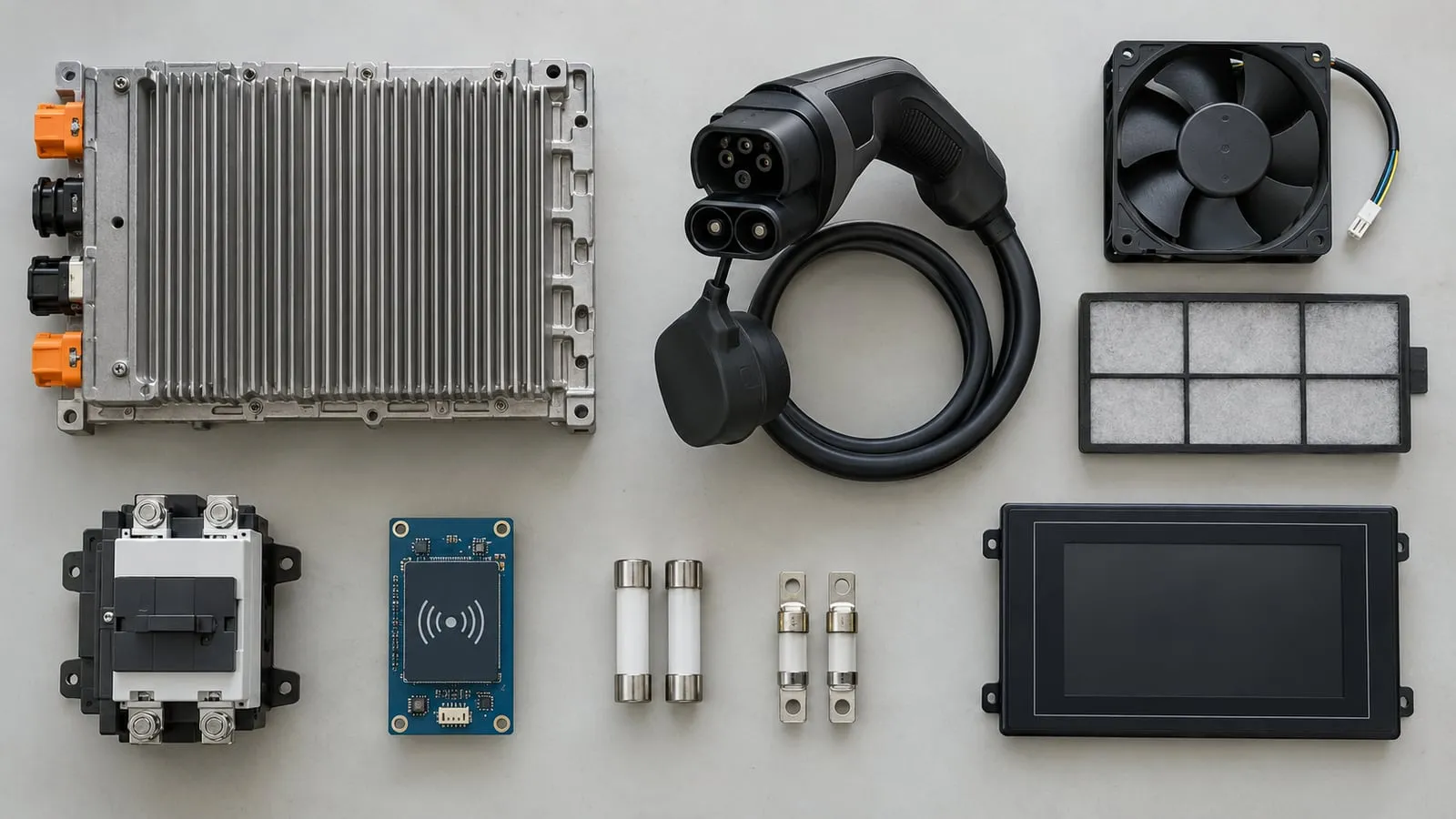
- 1Group spare parts into three tiers: consumables (filters, fuses), first-line parts a technician can swap on site (connectors and cables, RFID readers, fans, boards), and high-value parts held centrally (DC power modules, displays, main contactors).
- 2Size the stock from four numbers: how many chargers you run, the replacement rate the supplier can show from field data, the lead time to get parts to your country, and how much a day of downtime costs.
- 3Connectors and cables are the most exposed parts of any public charger — drivers drop them, drive over them and pull on them. Keep them in stock for every connector type you operate.
- 4Agree spare-parts prices, minimum stock at the supplier and shipping times in the contract, not after the first failure.
Contents
Short answer: for the first year, stock three tiers of parts. Consumables — air filters and fuses. First-line parts that a technician can swap on site — connectors and cables, RFID readers, fans, control boards, relays and contactors. High-value parts held at a central hub — DC power modules, displays and main contactors. Size each line from your installed base, the replacement rate the supplier can show from field data, the lead time to your country and the cost of a day of downtime, and put prices and shipping times in the contract.
Why spare parts decide uptime
A charger that waits three weeks for a part is down for three weeks, whatever its warranty says. Public charging rules increasingly measure this: the UK requires rapid charging networks to average 99 % reliability, and US NEVI sites must reach 97 % uptime per port. A local stock of the right parts is the cheapest way to meet those numbers.
Three tiers of spare parts
The list: AC chargers
| Part | Why it is replaced | Tier | Stock notes |
|---|---|---|---|
| Tethered cable with connector, or socket | Wear, vehicle damage, pulled or dropped connectors | 2 | One per connector type; most exposed part of any public charger |
| RFID reader / card board | Vandalism, moisture, wear | 2 | Small and quick to swap |
| Control board | Electronic faults, surge damage | 2 | Check firmware version compatibility |
| Contactor or relay | Contact wear on heavily used chargers | 2 | Match the exact rating |
| Display or LED board | Impact, sunlight, moisture | 2–3 | Only if your models have screens |
| Residual-current protection device | Fault or nuisance tripping | 2 | If the charger has an internal device |
| Fuses, seals, labels | Routine | 1 | Low cost |
The list: DC chargers
| Part | Why it is replaced | Tier | Stock notes |
|---|---|---|---|
| Power module | Electronic failure, overheating, surge | 3 | Many chargers keep running at reduced power without one module — check your model |
| Fans | Bearing wear, dust | 2 | Higher use in hot, dusty climates |
| Air filters | Clogging | 1 | Planned replacement; clogged filters cause derating |
| Charging cable and connector (CCS1, CCS2, NACS, CHAdeMO) | Wear, vehicle damage, pin damage | 2–3 | Heavy and costly; at least one per connector type per region |
| Main DC contactors | Wear under high current | 2–3 | Match the exact model |
| Insulation monitoring device, control and communication boards | Electronic faults | 2 | Firmware matching needed |
| Touchscreen / display | Impact, UV, moisture | 3 | Larger screens are costly |
| Payment terminal | Vandalism, faults | 2–3 | Often supplied by the payment provider |
How much to stock
A simple way to size each line:
Stock = installed units × annual replacement rate × (lead time in days ÷ 365) + safety stock
- Installed units: how many chargers (or connectors, or modules) use this part.
- Annual replacement rate: ask the supplier for field data on their models; revise it with your own data after a year.
- Lead time: from ordering to the part arriving at your hub — including customs.
- Safety stock: at least one unit of every Tier 2 part per connector type, and more where downtime is expensive (motorway sites, fleet depots).
Rework the numbers every quarter in the first year; your own failure data quickly becomes more reliable than any general estimate.
Organising the stock
- Label parts by charger model and firmware version — a control board from a different hardware revision may not work.
- Keep a swap record: serial of the part removed, serial of the part fitted, charger, date. It speeds up warranty claims and shows patterns.
- Return failed parts under warranty with the record; root-cause analysis prevents repeat failures.
- Train first-line technicians on safe replacement of Tier 2 parts; keep DC power-module and high-voltage work for trained staff.
Spare parts for VULTAE chargers
Ask for the recommended spare-parts list and prices for your models when you order, and agree stock and shipping times in the contract. See also our warranty and support page and the DC power module guide.
Questions buyers ask
- What spare parts should I keep for EV chargers?
- For AC chargers: sockets or tethered cables with connectors, RFID readers, control boards, contactors or relays and displays. For DC chargers add power modules, fans and air filters, insulation monitoring and control boards, contactors, cables and connectors, and touchscreens. Keep consumables such as filters and fuses for planned maintenance.
- How many spare parts do I need?
- Estimate the expected replacements during the lead time to get a part, then add a safety margin: installed units × annual replacement rate × lead time in years, plus a safety stock. Use the supplier’s field data for the replacement rate and revise it after your first year.
- Which charger parts fail most often?
- On public chargers, the parts handled by drivers — cables, connectors and holsters — and parts exposed to the environment, such as fans and air filters on DC units, need the most attention. Ask your supplier for field data on their models rather than relying on general rules.
- Should spare DC power modules be kept on site?
- Usually not at every site. Power modules are expensive, so most operators keep them at a regional hub and send them with the technician. Many DC chargers keep running at reduced power when one module fails, which buys time.
- Are spare parts covered by the warranty?
- Parts that fail from a defect during the warranty period are replaced under warranty; the stock you hold yourself is a separate purchase that keeps chargers running while warranty parts are shipped.
References
- [1]Procurement and installation for electric vehicle charging infrastructure. U.S. Department of Energy.
- [2]The Public Charge Point Regulations 2023 guidance (reliability requirement). GOV.UK.