Charging Business
Site Selection for Public DC Fast Charging: A Scoring Method
How to choose sites for public DC fast charging: demand, dwell time, grid capacity, visibility, competition and land terms, with a scoring sheet.
- Prepared by
- VULTAE Engineering Team
- Published
- Reading time
- 4 min
- Sources
- 2 references
Key takeaways
- 1A good fast-charging site combines four things: enough passing or visiting EVs, a reason to stop for 15–40 minutes, affordable grid capacity close by, and land terms that last as long as the equipment.
- 2Grid capacity can make or break a site. Ask the utility early what is available and what an upgrade would cost — a cheap site with an expensive connection is an expensive site.
- 3Score sites with the same weighted sheet, and visit the shortlist at the times drivers would charge. Data from charging maps and traffic counts beats intuition.
- 4Plan for growth: space and ducts for more chargers, and a connection that can be upgraded without starting again.
Contents
Short answer: a public DC fast-charging site needs demand (enough passing or visiting EVs), a reason to stop for 15–40 minutes, grid capacity close by at a reasonable cost, visibility and easy access, and land terms that outlast the equipment. Score every candidate with the same weighted sheet, check the grid before you sign, and leave room to grow.
The seven factors
| Factor | What to look for | Data |
|---|---|---|
| 1. Demand | Traffic or visitors per day; local EV share and its growth; fleets nearby | Traffic counts, vehicle registrations, site owner data |
| 2. Dwell and amenities | Toilets, food, shop, Wi-Fi, lighting; open long hours | Site visit |
| 3. Access | Directly on the route; easy in and out; space for vans and trailers | Maps, site visit |
| 4. Visibility | Seen from the road; signage allowed | Site visit, planning rules |
| 5. Grid | Spare capacity; distance to a transformer; upgrade cost and time | Utility capacity check |
| 6. Competition | Other fast chargers nearby, their power, occupancy and reliability | Charging maps and apps |
| 7. Land terms | Lease length, rent or revenue share, rights to expand, exclusivity | Draft agreement |
A weighted scoring sheet
Give each factor a score from 1 (poor) to 5 (excellent), multiply by the weight and add up. Adjust weights to your strategy — a fleet-focused operator may weight anchor customers higher.
| Factor | Weight | Site A | Site B | Site C |
|---|---|---|---|---|
| Demand | 25 % | |||
| Dwell and amenities | 15 % | |||
| Access | 10 % | |||
| Visibility | 10 % | |||
| Grid capacity and cost | 20 % | |||
| Competition | 10 % | |||
| Land terms | 10 % | |||
| Weighted total | 100 % |
Any site that scores 1 on grid or land terms should usually be dropped, whatever its total.
Demand: from traffic to sessions
A simple estimate per day:
Sessions = vehicles passing or visiting × share that are EVs × share of those that would charge here
Then energy per day = sessions × average energy per session (often 25–40 kWh at highway DC sites, depending on the vehicles and dwell time). Compare the result with the break-even utilization of the planned chargers. Cross-check with real data: occupancy of nearby chargers in apps, and conversations with local taxi, ride-hailing and delivery fleets — an anchor fleet can make a marginal site viable.
Site types compared
| Site type | Strengths | Watch out for |
|---|---|---|
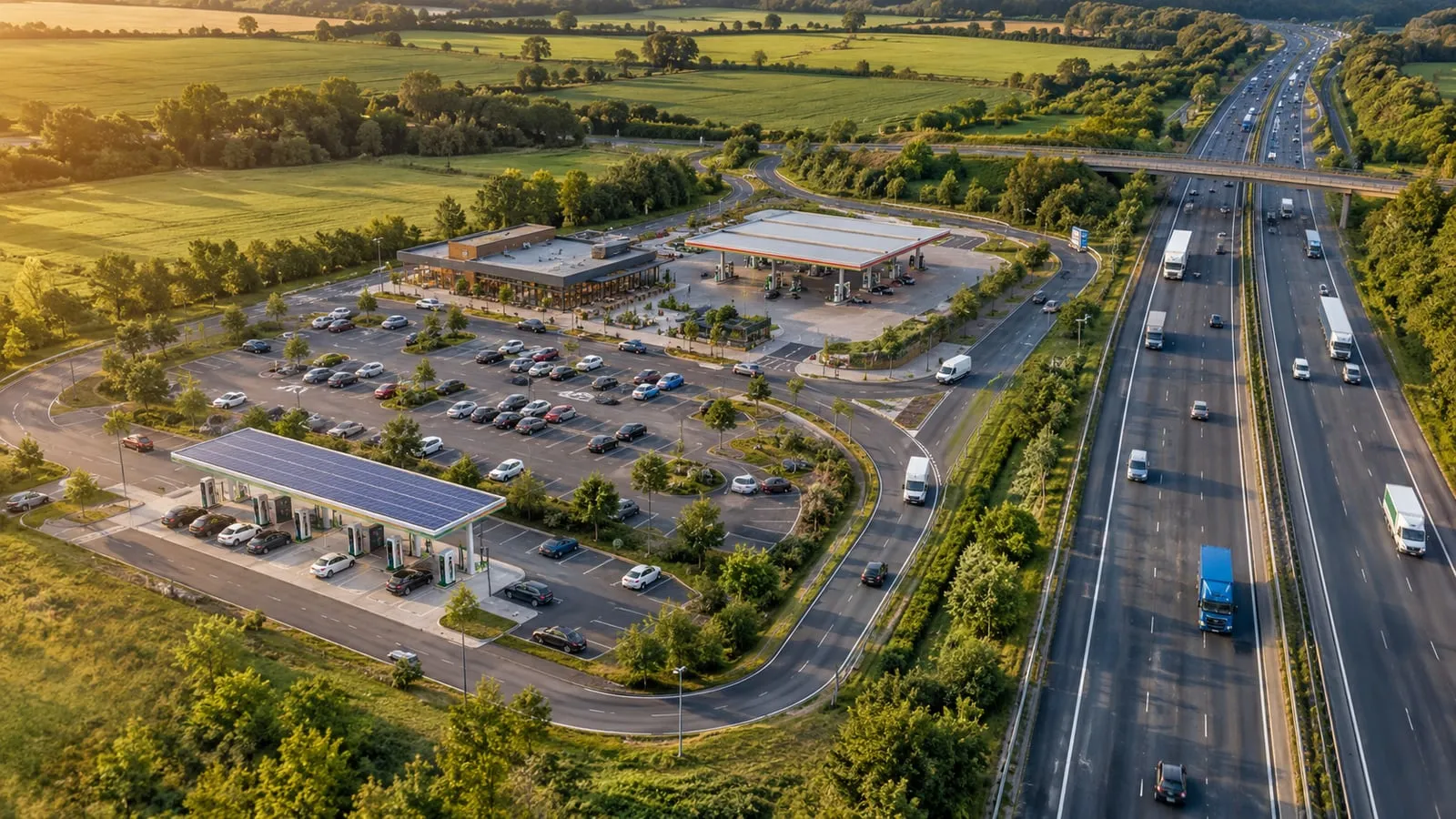
| Motorway service areas | Long-distance traffic, amenities, visibility | High land cost, concessions, medium-voltage connection |
| Fuel stations | Familiar to drivers, shop, canopy | Forecourt space, fuel-traffic conflicts |
| Supermarkets and retail parks | Visits of 20–45 minutes, high footfall | Opening hours, landlord terms |
| Urban hubs | Taxis, ride-hailing, residents without home charging | Land cost, grid capacity in cities |
| Restaurants and roadside cafés | Natural dwell time | Smaller grid connections |
| Logistics areas | Fleet anchor customers | Little amenity for private drivers |
The grid check
Before signing a lease, ask the utility:
- How much capacity is available at the nearest transformer?
- What would a new or upgraded connection cost, and how long would it take?
- Which tariffs apply — and are there demand charges? (See demand charges.)
- Can capacity be increased later on the same connection?
A site with good traffic but a long, expensive connection may still be worth it — but only if the score and business case include that cost. Details in grid power for DC sites.
Regulation and corridors
Public policy can create or remove demand. In the EU, AFIR requires charging pools at regular intervals on the TEN-T network; in the US, funded programmes have targeted corridors. Being early on a required corridor can be an advantage — or a reason to expect competition soon.
Visit at the right time
Visit the shortlisted sites at the times your users would charge — Friday evenings on highways, Saturday midday at retail parks, early morning at taxi hubs. Check queuing traffic, lighting, safety, mobile signal for the chargers’ 4G connection, and where the cable route and transformer would go.
Leave room to grow
- Bays and space for twice the first phase.
- Ducts to future bays laid in the first works.
- A connection that can be upgraded without a new substation.
- Lease rights to add chargers.
Compact DC cabinets help where space is limited — see EV charging at fuel stations and highways.
Questions buyers ask
- What makes a good location for an EV fast-charging station?
- High traffic or visitor numbers with a growing share of EVs, amenities that give drivers something to do for 15–40 minutes, easy access from main roads, grid capacity nearby at a reasonable cost, good visibility, and a long, secure land agreement.
- How do I estimate demand at a potential site?
- Start with traffic counts or visitor numbers, multiply by the local share of EVs and the share likely to charge there, and cross-check with the occupancy of nearby public chargers shown on charging apps. Anchor customers such as taxi or delivery fleets can secure a baseline.
- How important is the grid connection when choosing a site?
- Very. The cost and time to connect a DC site vary enormously with local network capacity. Ask the utility for a capacity check before you sign a lease, and include the connection in the site score.
- How long should a land lease for a charging site be?
- At least as long as the expected life and financing period of the equipment — often 10 years or more — with options to extend and to add chargers.
References
- [1]Regulation (EU) 2023/1804 on alternative fuels infrastructure (AFIR). EUR-Lex.
- [2]Alternative Fuels Data Center — station locator. U.S. Department of Energy.