Installation & Power
EV Chargers in Cold Climates: Snow, Frost and Condensation
How cold weather affects EV chargers and charging: low-temperature ratings, heaters, cable stiffness, snow and ice, battery limits and installation tips.
- Prepared by
- VULTAE Engineering Team
- Published
- Reading time
- 3 min
- Sources
- 3 references
Key takeaways
- 1Cold affects three things: the charger electronics (start-up and condensation), the cable and connector (stiffness, ice) and the car’s battery, which charges slower when cold. The last one is the car, not the charger.
- 2Check the rated low temperature and how the charger starts at that temperature: does it include heaters for the controller, the display and the connector? A cold start from −30 °C is a different test from running at −10 °C.
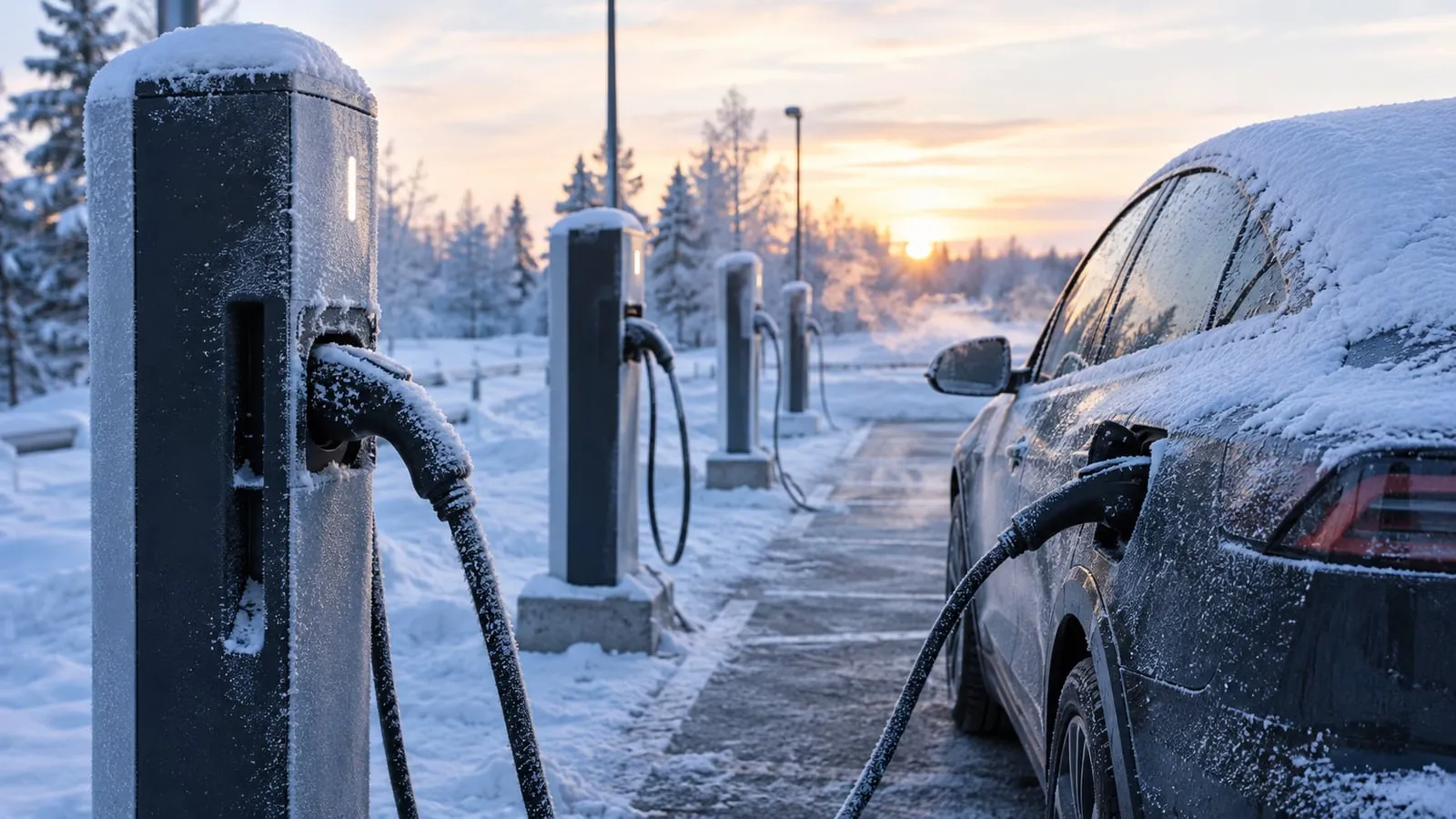
- 3Snow and ice need design attention: raise the charger above snow level, keep cable holsters from freezing and plan snow clearing around bays.
- 4Condensation is the quiet killer: cold-to-warm transitions form water inside enclosures. Heaters, breathers and sealed designs reduce it.
Contents
Short answer: cold affects the charger electronics, the cable and connector and the car’s battery. Choose a charger rated for your lowest site temperature with a cold-start capability, plan for snow, ice and condensation, and remember that slow winter charging is usually the battery, not the charger.
What cold does
| Part | Effect | Remedy |
|---|---|---|
| Controller, display, relays | May not start below their rating; LCDs slow down | Heater, wide-temperature components |
| Enclosure | Condensation when it warms; ice on seals | Heater, breather vent, sealed design |
| Cable | Stiff, hard to coil; jacket may crack | Low-temperature cable; holder at the right height |
| Connector | Ice in the latch; frozen pins | Cover, drainage, heated connector option |
| Battery in the car | Accepts less power until warm | Precondition the battery; this is a vehicle behaviour |
| Power modules (DC) | Need to warm up before full power | Self-heating from idle; wait |
Specs to check
| Item | What to look for |
|---|---|
| Operating temperature | Lowest rated temperature (−20, −25, −30 °C or lower) |
| Cold-start | Can it start after sitting at that temperature? How long to warm? |
| Heaters | In the cabinet, display, connector? Power use? |
| Cable rating | Low-temperature cable type; minimum bending temperature |
| Holster and cover | Drains water; can be cleared |
| Snow loads | Mounting height and roof if any |
Some product lines offer an ultra-low-temperature option; ask for it explicitly for sites below −25 °C.
Site design
- Height. Mount the charger and connector holder above the maximum snow depth.
- Drainage. Water must run away from the base; ice around a plinth heaves foundations.
- Snow clearing. Plan where ploughs push snow; add bollards and markers so that machines do not hit chargers.
- Shelter. A canopy keeps snow off bays and cables.
- Cable management. Use holders and retractors so that cables do not lie in slush — see cable management.
- Lighting. Winter nights are long; light bays well.
Condensation
When a cold charger warms, moisture condenses inside. Over time it corrodes terminals and causes earth faults and nuisance RCD trips — see troubleshooting. Remedies: an anti-condensation heater, a pressure-equalising breather, sealed glands and a desiccant where the manufacturer allows. Do not seal a cold enclosure without a breather if the design needs one.
Charging in the cold: what drivers see
- Slower charging for the first 10–30 minutes while the battery warms.
- Higher energy use in the car for cabin heating and battery heating.
- Shorter range, so more people need fast chargers on routes.
Many modern cars precondition the battery when you navigate to a fast charger. For site planning in cold regions, add capacity for slower sessions — see the charging calculator.
Questions for the supplier
- What is the lowest rated temperature and is there an option below it?
- What heaters are included and how much power do they draw while idle?
- Is the cable rated for low temperature?
- How does the charger behave in a cold start, and how long to full power?
- What is the maintenance advice for snow, ice and salt?
VULTAE chargers
Operating ranges of VULTAE chargers go down to −20 °C or −25 °C depending on the series, and some DC series offer an ultra-low-temperature option; the upper limit is +55 °C. Tell us the lowest site temperature when you ask for a quote, and we will confirm the right model and options. The installation requirements guide and the hot-climate article cover the other end of the range.
Questions buyers ask
- Can EV chargers work in freezing temperatures?
- Yes, if they are rated for it. Many chargers list operating ranges from −20 °C or −25 °C; some have options for lower temperatures. Check the data sheet for the exact range and for any heaters.
- Why do electric cars charge slowly in the cold?
- The battery must be warm to accept high power. A cold battery limits charging current, and the car may spend time warming it first. Preconditioning before arrival helps. This is a vehicle effect, not a charger fault.
- Does cold damage charging cables?
- Cables stiffen in the cold, and some jackets crack if bent below their rated temperature. Choose cables rated for low temperature, keep them off the ground and avoid sharp bends.
- How do I stop ice in the connector?
- Use a holster that drains water and has a cover, fit a heated connector if offered, and avoid leaving the connector hanging in freezing rain. Always check the pins before inserting.
References
- [1]IEC 61851-1:2017 — general requirements. International Electrotechnical Commission.
- [2]IEC 61851-23:2023 — DC electric vehicle supply equipment. International Electrotechnical Commission.
- [3]Alternative Fuels Data Center: electricity infrastructure development. U.S. Department of Energy.