Portable & Mobile Charging
Travelling With a Portable EV Charger: Adapters and Rules
Taking a portable EV charger abroad: voltage and frequency, rated plug adapters, socket condition, safe current settings and the local rules to check first.
- Prepared by
- VULTAE Engineering Team
- Published
- Reading time
- 2 min
- Sources
- —
Key takeaways
- 1A portable charger abroad must support the local voltage and frequency, use a plug or adapter rated for charging current and be set to a current the local socket and circuit can carry.
- 2Cheap travel adapters are made for a few amps; at charging current they overheat. Use rated plugs and avoid chains of adapters or extension leads.
- 3Check the connector your car needs, local rules on charging from sockets (especially in hotels and rented properties) and ask permission before you plug in.
Contents
Short answer: before you travel check voltage and frequency, pack rated plugs, set a safe current for each socket and look up local rules. Avoid generic travel adapters, extension leads and chains of adapters.
Pre-trip checklist
| Check | Why it matters |
|---|---|
| Charger voltage and frequency range | The charger must be built for the local supply (for example 230 V at 50 Hz or 120 V at 60 Hz) |
| Connector on the car | Type 2, Type 1, CCS, GB/T or NACS decides the cable and any adapter |
| Plug or adapter rating | Charging draws far more current than a phone or laptop |
| Socket and wiring condition | A worn or loose socket heats up |
| Current setting | Match the circuit, not the charger’s maximum |
| Local rules | Hotels, rented property and public places can have rules |
| Spare items | Carry bag, cable hook, torch to check sockets in the dark |
Voltage and frequency
Many portable chargers accept a range of voltages and both 50 and 60 Hz, but not all. If the label does not say 100–240 V or similar, check with the manufacturer before using it on a different supply. A charger built for 230 V does not work properly on 120 V, and may not work at all.
Plugs and adapters
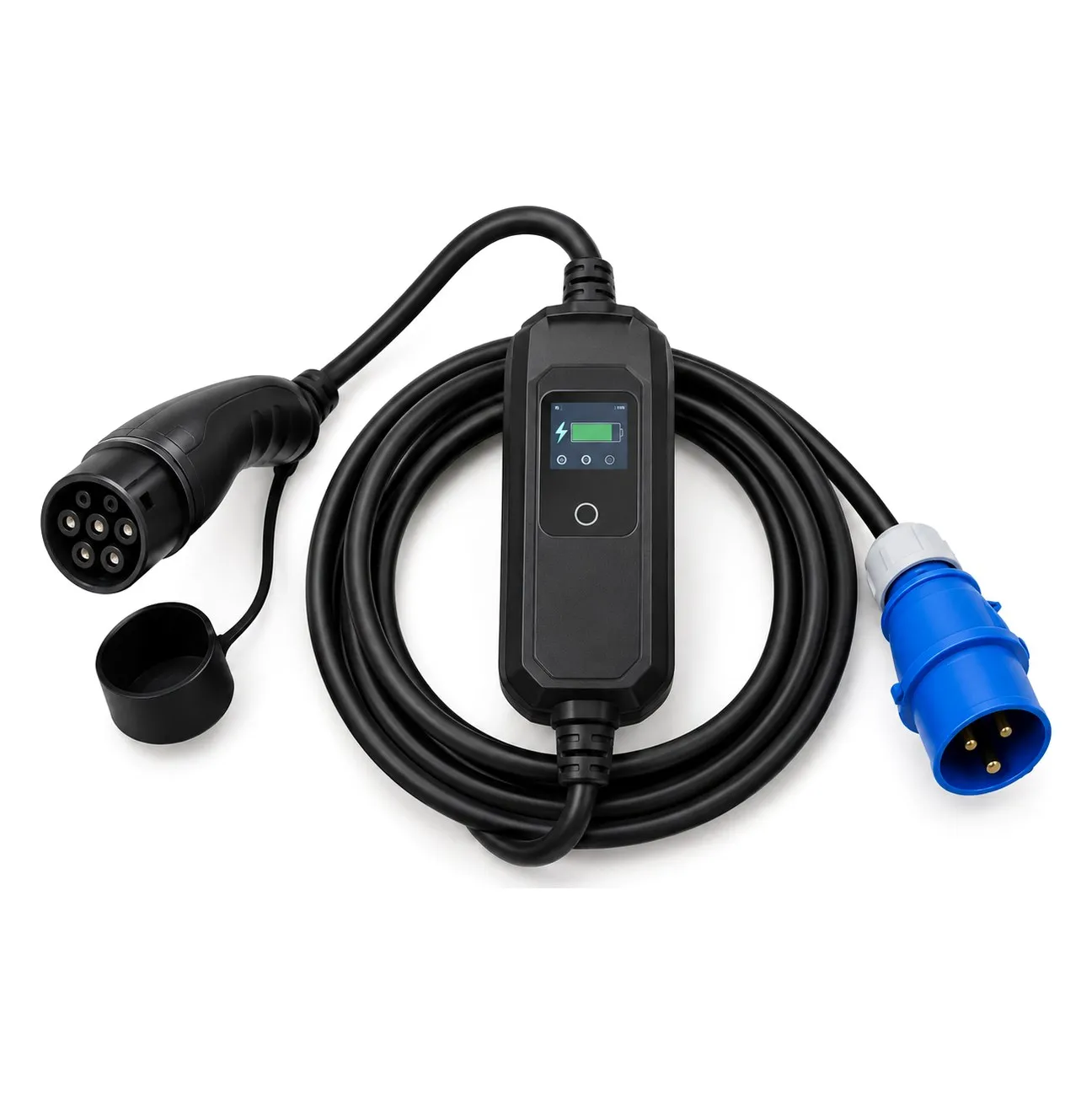
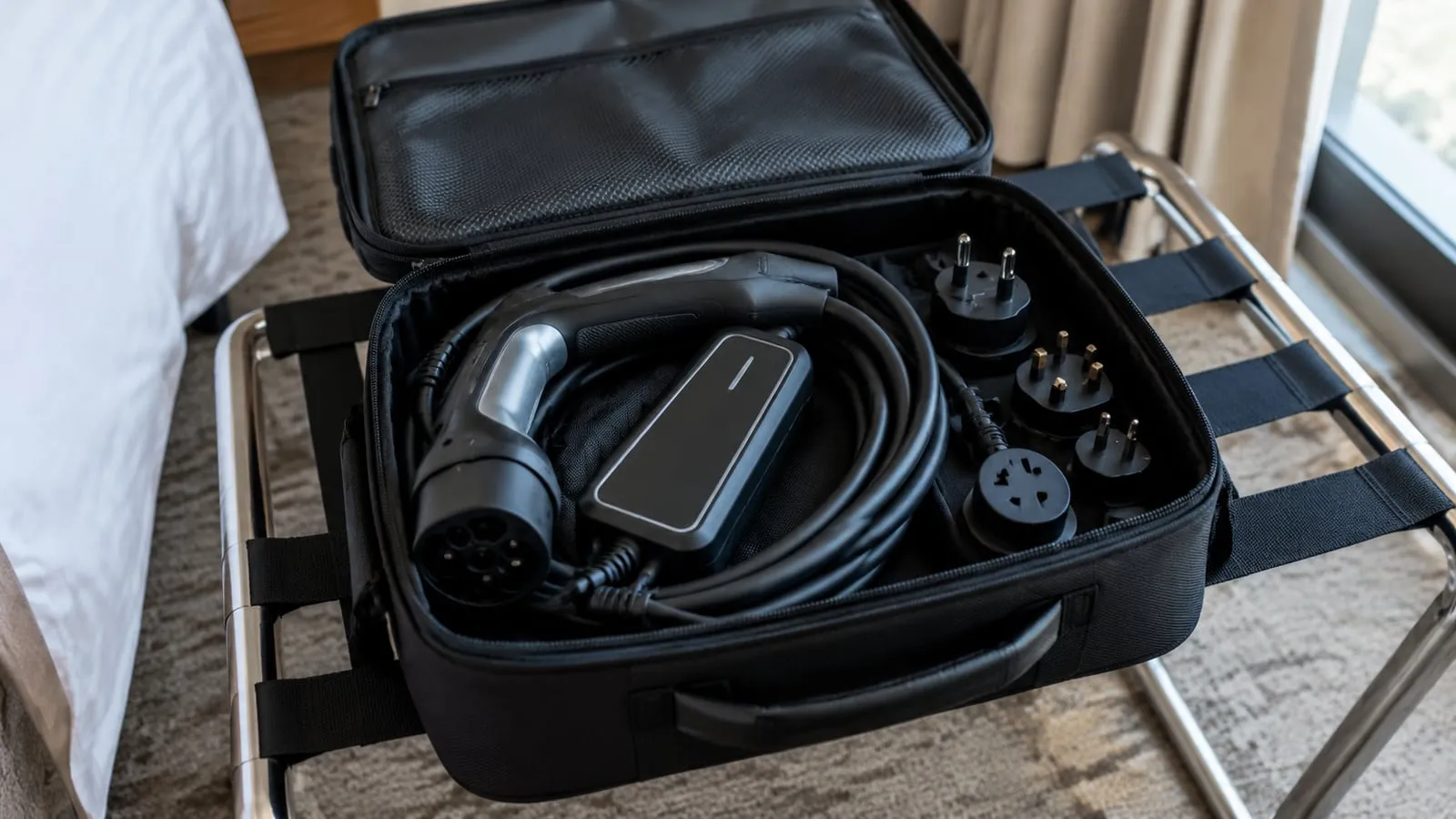
- Use the plug supplied for the country, or a purpose-made plug rated for the current.
- Do not chain adapters.
- Check the plug for heat after 10–15 minutes of charging.
- Industrial sockets (blue single-phase and red three-phase IEC 60309 types in Europe) allow higher current but need a matching plug; see plug types by country.
Setting the current
| Situation | Suggested approach |
|---|---|
| Old or unknown household socket | Low current (6–8 A), check for heat |
| Good household socket on a modern circuit | Moderate current, within the socket and circuit rating |
| Industrial socket on a suitable circuit | Higher current as rated |
| Extension lead | Avoid |
Use the charger’s current setting rather than hoping the socket copes; see in-cable control box safety checks.
Rules and etiquette
- Ask permission at hotels and rented properties and pay for the electricity if asked.
- Check whether the local rules restrict Mode 2 charging in public places — see charging modes.
- Prefer public chargers for long stays; use the portable charger as a backup.
When a portable charger is the wrong tool
If you charge the same place often, a fixed charger is safer and faster. See portable charger vs wallbox. VULTAE’s portable charger has an adjustable current of 6–16 or 6–32 A depending on the model and is available with adapter plugs for regional sockets; see also cables and adapters.
Questions buyers ask
- Is it safe to use a portable charger in another country?
- Yes if the charger supports the local voltage and frequency, the socket and wiring are sound, the plug or adapter is rated for the current and you set the current correctly. If unsure, use a lower current or find a fixed charger.
- Can I use an ordinary travel adapter?
- Not for charging. Travel adapters are usually rated for a few amps. Use a purpose-made plug rated for the current, or the plug supplied with the charger.
- Should I ask permission to charge at a hotel or rented house?
- Yes. Sockets and circuits differ, and the owner is responsible for the installation. Ask first and charge at a low current on a socket they approve.