OEM & Private Label
OEM vs ODM vs White Label EV Chargers: Which Model Fits Your Brand
White label, OEM and ODM are not the same. Compare control, cost, certification and timeline, and pick the model that fits your brand and volume.
- Prepared by
- VULTAE Engineering Team
- Published
- Reading time
- 2 min
- Sources
- —
Key takeaways
- 1White label means the factory’s finished product with your logo. OEM means the factory builds to your specification. ODM means the factory designs and builds a product that you then sell under your brand. The more control you want, the more time, volume and certification work you take on.
- 2Certification follows the product, not the brand: a certificate for the factory’s model does not automatically cover a changed design or a different brand name. Agree who applies for what before you order.
- 3Start with white label or light OEM (logo, colour, packaging) to test the market, then move to deeper OEM or ODM when volume justifies tooling and firmware work.
Contents
Short answer: white label = the factory’s finished charger with your logo. OEM = the factory builds a charger to your specification. ODM = the factory designs a charger that you sell under your name. Choose by how much control you need, how many units you will order, and who carries the certification work.
The three models side by side
| White label | OEM | ODM | |
|---|---|---|---|
| Who designs | Factory | You (or jointly) | Factory, adapted to your brief |
| What you change | Logo, packaging | Shell colour, screen, app, firmware features | Housing, features, firmware, sometimes hardware |
| Typical volume | Small to medium | Medium to large | Medium to large |
| Time to first units | Weeks | Months | Months |
| Certification | Factory certificates may apply; check the brand and model scope | New or extended certification likely | New certification for changed design |
| Main risk | Looking like every other brand | Cost and delays of customisation | Dependence on the factory’s platform |
What “customisation” can mean
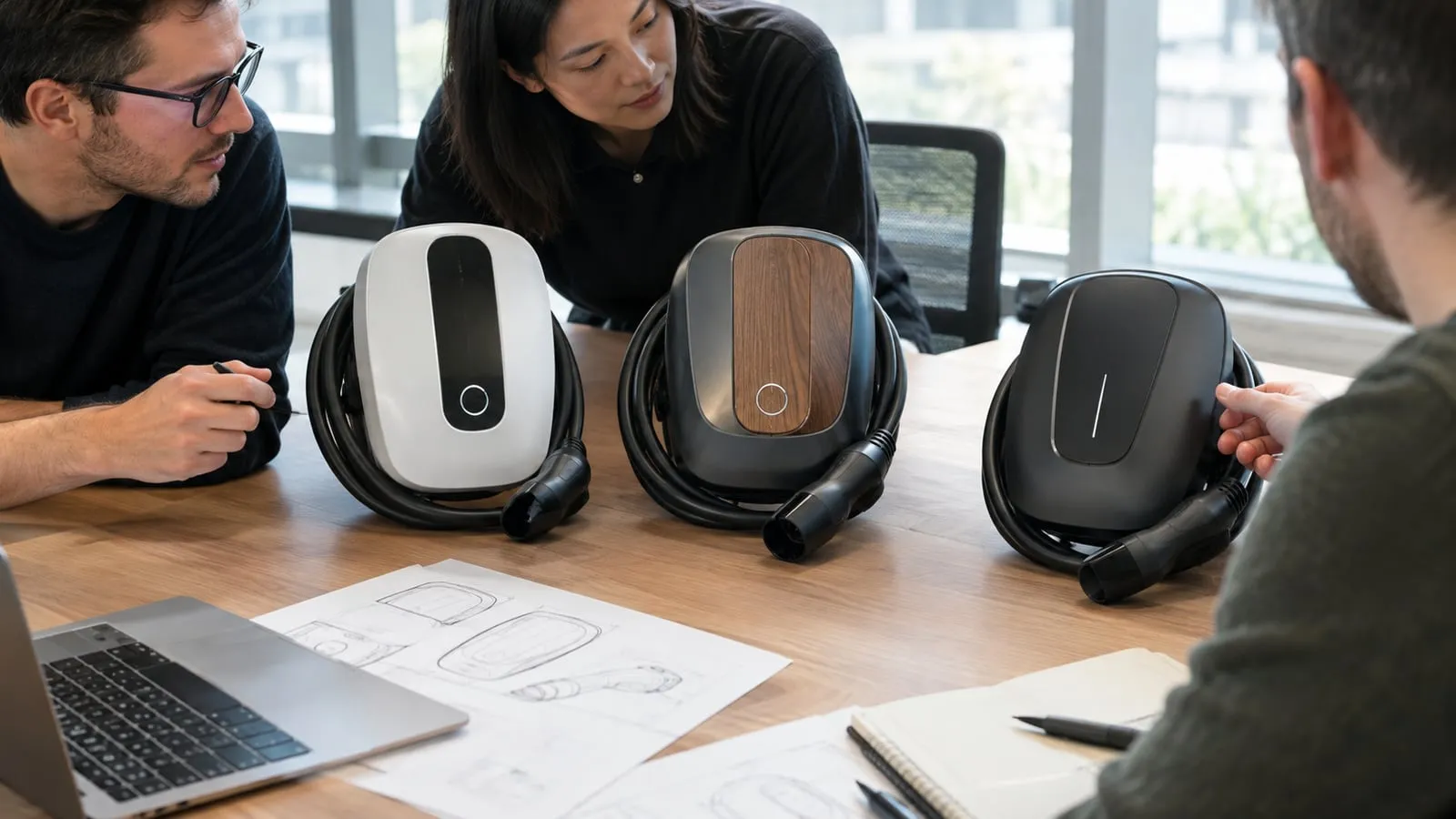
- Surface: logo plate, shell colour, packaging, manuals and labels.
- Interface: screen start-up image, LED colours, language packs, app branding.
- Software: OCPP back-end connection, feature set, start modes (RFID, app, plug & charge).
- Hardware: cable length, connector type, enclosure, mounting.
- Platform: firmware ownership, over-the-air updates, your own app and back end.
Every layer further down this list takes longer and touches certification.
Certification is the hidden step
A test report or certificate names a model, a holder and a scope. If you change the housing, the board or the brand on the label, ask the certification body what must be repeated. See certification after rebranding and how to verify a certificate.
How to choose
| Your situation | Best starting point |
|---|---|
| Testing a market with a small order | White label or light OEM |
| Distributor who wants its own brand on a proven range | OEM on an existing platform |
| Brand with its own software and design language | OEM with firmware and app agreement |
| Brand that wants a unique product and has volume | ODM, with a clear tooling and exclusivity agreement |
Questions to put in the brief
- Which models and versions (IEC or North American) can carry my brand?
- Who applies for and holds the certificates?
- Who owns the firmware, the app and the back-end connection?
- What minimum order, sample cost and lead time apply?
- What exclusivity, if any, covers my design?
Our OEM / ODM page lists what VULTAE can customise, and the private-label guide walks through the steps.
Questions buyers ask
- What is the difference between OEM and ODM?
- In OEM the buyer supplies or approves the specification and the factory builds to it; in ODM the factory supplies the design and the buyer sells it under its own brand, with limited changes. In practice the terms overlap, so write down exactly what you can change.
- Is white label cheaper than OEM?
- Usually the lowest entry cost, because the product exists and certificates are in place. Deeper customisation adds sample, tooling, firmware and certification costs.
- Who owns the firmware and the app in a white-label deal?
- Usually the factory, unless the contract says otherwise. If a branded app or a change in firmware matters to you, agree ownership, source access and update rights in writing.