Installation & Power
Voltage Drop on Long EV Charger Cable Runs
Long cable runs to EV chargers lose voltage. How to estimate the drop, the usual limits, when to upsize the cable and why it affects charging.
- Prepared by
- VULTAE Engineering Team
- Published
- Reading time
- 1 min
- Sources
- —
Key takeaways
- 1Voltage drop is the loss of voltage along a cable. It grows with current and cable length and shrinks as the conductor gets thicker.
- 2Many wiring rules set a limit on total drop, often a few percent. A charger running at full current for hours is a demanding load, so check the drop on long runs.
- 3The fix is usually a larger cable, a shorter route or moving the supply point closer. Check the rules in your country and have the electrician calculate the circuit.
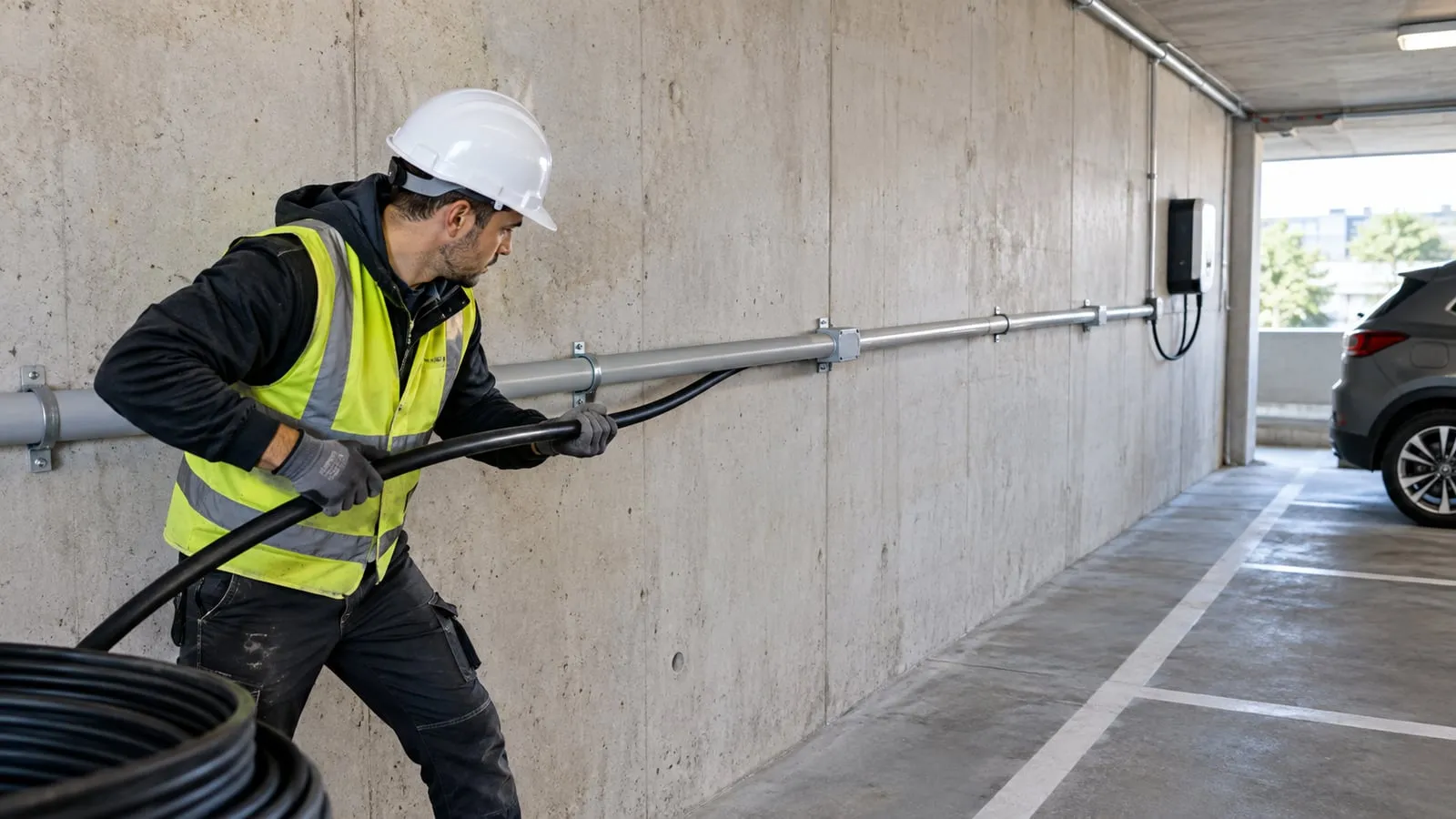
Short answer: voltage drop depends on current, length and conductor size. For a long run to a charger, calculate the drop and upsize the cable if it exceeds the limit in your wiring rules.
The idea
Cable has resistance. Current flowing through it makes a voltage drop, so the charger sees a lower voltage than the board. The drop is highest at full current, which is how chargers run.
| Factor | Effect on drop |
|---|---|
| Higher current | Higher drop |
| Longer run | Higher drop |
| Thicker conductor | Lower drop |
| Copper vs aluminium | Aluminium needs a larger size for the same drop |
| Single-phase vs three-phase | Three-phase carries the same power at lower current per conductor |
Worked example (indicative)
A 7.4 kW single-phase charger at 32 A over 50 m on a 6 mm² copper cable: the drop can approach or exceed typical limits, and moving to 10 mm² reduces it. The exact figure depends on the cable table, installation method and temperature, so ask the electrician to calculate it.
Practical steps
- Measure the real route length, not the straight line.
- Choose a cable size that meets both current capacity and drop limits — see wire size tables.
- Consider three-phase to lower current — see single-phase vs three-phase.
- Move the supply point closer, for example with a sub-board.
- Document the calculation in the commissioning record.
When it matters most
- Remote parking spaces and large car parks.
- Pedestals far from the board.
- Higher power chargers (22 kW and DC).
The installation requirements guide covers the whole circuit.
Questions buyers ask
- Does voltage drop slow charging?
- A small drop has little effect. A large drop can cause the charger or car to reduce current or trip on undervoltage, and it wastes energy as heat in the cable.
- How do I estimate voltage drop?
- Multiply current by cable resistance for the run, using the cable length (and both conductors for single-phase) and the cable table values. Your electrician or an online calculator can do this.
- When should I upsize the cable?
- When the calculated drop exceeds the allowed limit, when the run is long, or when you want margin for future power. The breaker and cable must still match.