Certification & Compliance
MID Meters and Eichrecht: Billing-Grade Metering in Europe
When an EV charger needs a MID-approved meter, what Germany’s Eichrecht adds (signed data), and how buyers can check billing-grade metering.
- Prepared by
- VULTAE Engineering Team
- Published
- Reading time
- 3 min
- Sources
- 4 references
Key takeaways
- 1If you sell electricity by the kilowatt-hour, the meter that sets the bill is a legal measuring instrument. In the EU that normally means a meter approved under the Measuring Instruments Directive (MID, 2014/32/EU). A meter for internal information only does not need MID.
- 2Germany goes further. Eichrecht (calibration law) requires that the measured data can be proved to the customer: signed meter values, a link between the meter and the session, and software the customer can use to check the data.
- 3MID is a property of the meter. Eichrecht compliance is a property of the whole system: meter, charger firmware, back end and invoice. A MID meter inside a charger does not make the charger Eichrecht-compliant by itself.
- 4Home chargers that do not bill customers usually need neither. Workplaces, apartment buildings and public chargers that bill per kWh usually do.
Contents
Short answer: if you bill customers by the kWh, the meter is a legal measuring instrument. In the EU that means a MID-approved meter. Germany’s Eichrecht goes further and requires verifiable, signed data across the whole system, not just a certified meter. A charger that only informs its owner needs neither.
Which rule applies when
| Situation | Typical requirement |
|---|---|
| Private home charger, no billing | None. The built-in meter is for information |
| Employer reimburses a driver by kWh | Often a calibrated or MID meter; check local rules |
| Landlord bills tenants per kWh | MID meter, and local billing rules |
| Public charger priced per kWh (EU) | MID meter or a national equivalent; price per kWh must be shown — see AFIR |
| Public charger in Germany | MID meter plus Eichrecht system compliance |
| Public charger in Great Britain | Price per kWh and accuracy rules under the Public Charge Point Regulations 2023 |
| United States | State weights-and-measures rules; NIST Handbook 44 Section 3.40 is the model code |
Always check the rule of the country where the charger will be installed; this table shows the typical pattern, not a legal opinion.
What MID covers
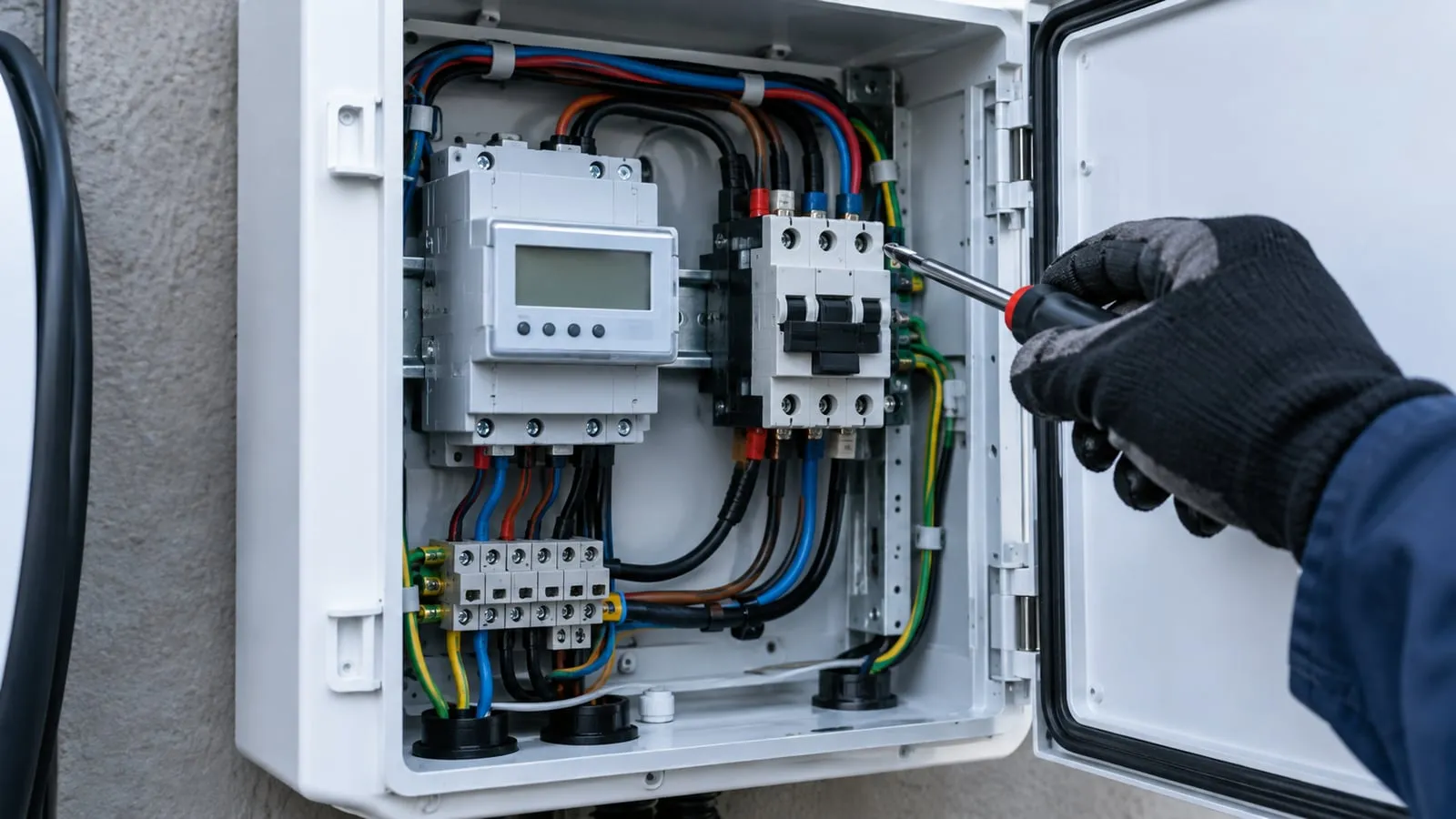
MID, the Measuring Instruments Directive 2014/32/EU, sets accuracy classes and tests for meters. For electricity meters the relevant annex is MI-003. A MID meter carries the CE mark, the metrological “M” mark and the year, followed by the number of the notified body. For single-phase and three-phase AC chargers, a direct-connected MID meter (up to 65 A or 100 A) is common; for larger DC chargers, a meter with current transformers or a DC meter is used. DC metering rules are newer and differ by market, so ask for the exact approval of the DC meter.
What Eichrecht adds
Eichrecht, the German calibration law, is about proof. The customer should be able to see that the energy on the invoice is the energy that was delivered. In practice charge points need:
- A meter that signs each reading cryptographically.
- A way to link the signed readings to the session, the start and end, and the user.
- Transparency software that the customer can use to check the signed data record.
- An invoice that points to the data, and an operator process for correction and maintenance.
This is why Eichrecht compliance is a system property. The meter, the charger firmware, the back end and the invoice must all fit together. A MID meter in a charger gives you the first step only.
What to ask a charger supplier
| Question | Why it matters |
|---|---|
| Is the meter MID-approved? Send the certificate with the notified-body number | Confirms billing-grade accuracy |
| Which model and firmware is the approval for? | Firmware changes can break compliance |
| Does the charger sign the meter data? Which format? | Needed in Germany; useful elsewhere for disputes |
| Which back ends are tested with it? | The signed data has to reach the invoice |
| Is the metering option available for every model you want? | Some series offer it only on request |
| Where is the meter calibrated and what is the re-verification interval? | Some countries require periodic checks |
Cost and delivery impact
Metering approval is not free. A MID meter adds cost and, for DC chargers, can add weeks to the approval. If you are unsure which markets you will sell in, decide this before you order, not after. The same logic applies to the certificates and to your tender specification.
How VULTAE handles it
A MID-certified meter is available on request for our commercial dual-gun AC chargers. For DC chargers, tell us the approval you need and we will confirm what is available for the exact model. Send the destination country and whether you bill per kWh with your enquiry, and we will confirm the metering option before quotation. For the wider rules on selling in Europe and the UK, see importing EV chargers into the EU and UK and the Europe and UK standards page.
Questions buyers ask
- What is a MID meter?
- A meter that has been assessed under the EU Measuring Instruments Directive 2014/32/EU (annex MI-003 for active electrical energy) and carries the CE and M marking with a notified-body number. It can be used as a legal basis for billing within the EU.
- Does every EV charger need a MID meter?
- No. A charger that only shows energy for the owner’s information does not. A charger that is used to bill third parties by kWh normally does, and local law can add more. Check the rules of the country where the charger will operate.
- What is Eichrecht?
- The German calibration law framework for measuring instruments. For charging, it expects billing data to be traceable and verifiable by the customer, so charge points use signed meter data, and the operator provides the customer with a way to check the data.
- Can I add a MID meter to a charger later?
- Sometimes, if the charger was designed for it. Retrofitting an external meter changes the product and can affect the charger’s safety and EMC documentation. It is safer to order the charger with the metering option from the start.
References
- [1]Directive 2014/32/EU — Measuring Instruments Directive. EUR-Lex.
- [2]Regulation (EU) 2023/1804 — AFIR. EUR-Lex.
- [3]The Public Charge Point Regulations 2023. legislation.gov.uk.
- [4]NIST Handbook 44, Section 3.40 — electric vehicle fueling systems. NIST.