Connectors & Protocols
EV Charger Cybersecurity Requirements: UK, EU and US
What cybersecurity rules apply to connected EV chargers in the UK, EU and US, how OCPP security profiles fit in, and what to ask a charger supplier.
- Prepared by
- VULTAE Engineering Team
- Published
- Reading time
- 3 min
- Sources
- 5 references
Key takeaways
- 1A connected charger is an internet device that controls high power. Rules now ask for secure design: no shared default passwords, signed firmware, encrypted communication, a way to report vulnerabilities and security updates for a stated period.
- 2EU: since 1 August 2025 internet-connected radio equipment, which includes chargers with Wi-Fi or cellular, must meet the RED cybersecurity requirements (Delegated Regulation 2022/30, standards EN 18031). The Cyber Resilience Act adds more from 2026–2027.
- 3UK: private chargers must meet the security requirements of the Electric Vehicles (Smart Charge Points) Regulations 2021. US: federally funded sites follow 23 CFR 680, and many states and utilities add their own rules.
- 4OCPP has three security profiles. Profile 3 (TLS with client certificates) is the strongest. Ask which profile the charger supports and which one your back end uses.
Contents
Short answer: a connected charger is an internet device that switches high power, and regulators now treat it that way. In the EU, internet-connected chargers have to meet RED cybersecurity rules (EN 18031) since 1 August 2025, with the Cyber Resilience Act following. In the UK, private chargers must meet the Smart Charge Points Regulations 2021. In the US, federally funded sites follow 23 CFR 680 plus state and utility rules. Ask the supplier for evidence, not promises.
Rules by market
| Market | Main rule | Applies to | Status |
|---|---|---|---|
| EU | RED Delegated Regulation 2022/30; EN 18031-1/-2/-3 | Chargers with Wi-Fi, cellular or other radio connection to the internet | In force since 1 Aug 2025 |
| EU | Cyber Resilience Act (2024/2847) | Products with digital elements | Reporting from 11 Sep 2026; main duties from 11 Dec 2027 |
| EU | AFIR (2023/1804) | Public chargers: communication and data standards | See importing into the EU and UK |
| UK | Smart Charge Points Regulations 2021 | Private charge points sold in Great Britain | In force |
| UK | Public Charge Point Regulations 2023 | Public chargers: reliability, data, payment | In force |
| US | 23 CFR 680 (NEVI) | Federally funded fast-charging stations | In force; check current text |
| US | State and utility rules | Varies | Check per project |
This is an overview, not legal advice; confirm the current text for your market.
What the rules ask for in practice
Reading across the regulations and the standards, a connected charger should have:
- No universal default password. Every unit gets a unique credential, or the user must set one on first use.
- Signed firmware. The charger accepts only updates signed by the manufacturer — see OTA firmware updates.
- Encrypted communication with the back end (TLS) and certificate checks.
- Secure storage of keys and credentials, and protection of personal data such as RFID tags and user accounts.
- Tamper protection for local interfaces: service ports, USB, debug pins.
- A way to report vulnerabilities and a published process for security patches.
- A support period: how long the manufacturer will provide security updates.
OCPP security profiles
OCPP defines how a charger secures its connection to the back end.
| Profile | Transport | Authentication | Use |
|---|---|---|---|
| 1 | Unencrypted WebSocket | Basic (username and password) | Closed private networks only |
| 2 | TLS | Server certificate + Basic authentication | Common minimum for production |
| 3 | TLS | Server and client certificates | Strongest; recommended for public networks |
OCPP 2.0.1 builds these profiles into the specification; OCPP 1.6 supports them through the security extension. The back end must support the same profile. For the version differences, see OCPP 1.6J vs 2.0.1.
What to ask a charger supplier
| Question | A good answer |
|---|---|
| Which security profile does the charger support? | Profile 2 and 3, tested with named back ends |
| Do you have RED / EN 18031 evidence for the EU? | A test report or declaration naming the model and the standard |
| How are default credentials handled? | Unique per device, or forced change at first use |
| How do you sign and deliver firmware? | Signed images; keys kept at the manufacturer |
| How long are security updates supported? | A stated number of years, in the contract |
| Where do I report a vulnerability? | A named security contact and a response process |
Put the answers into the tender specification so that they are part of the contract.
Don’t forget the site
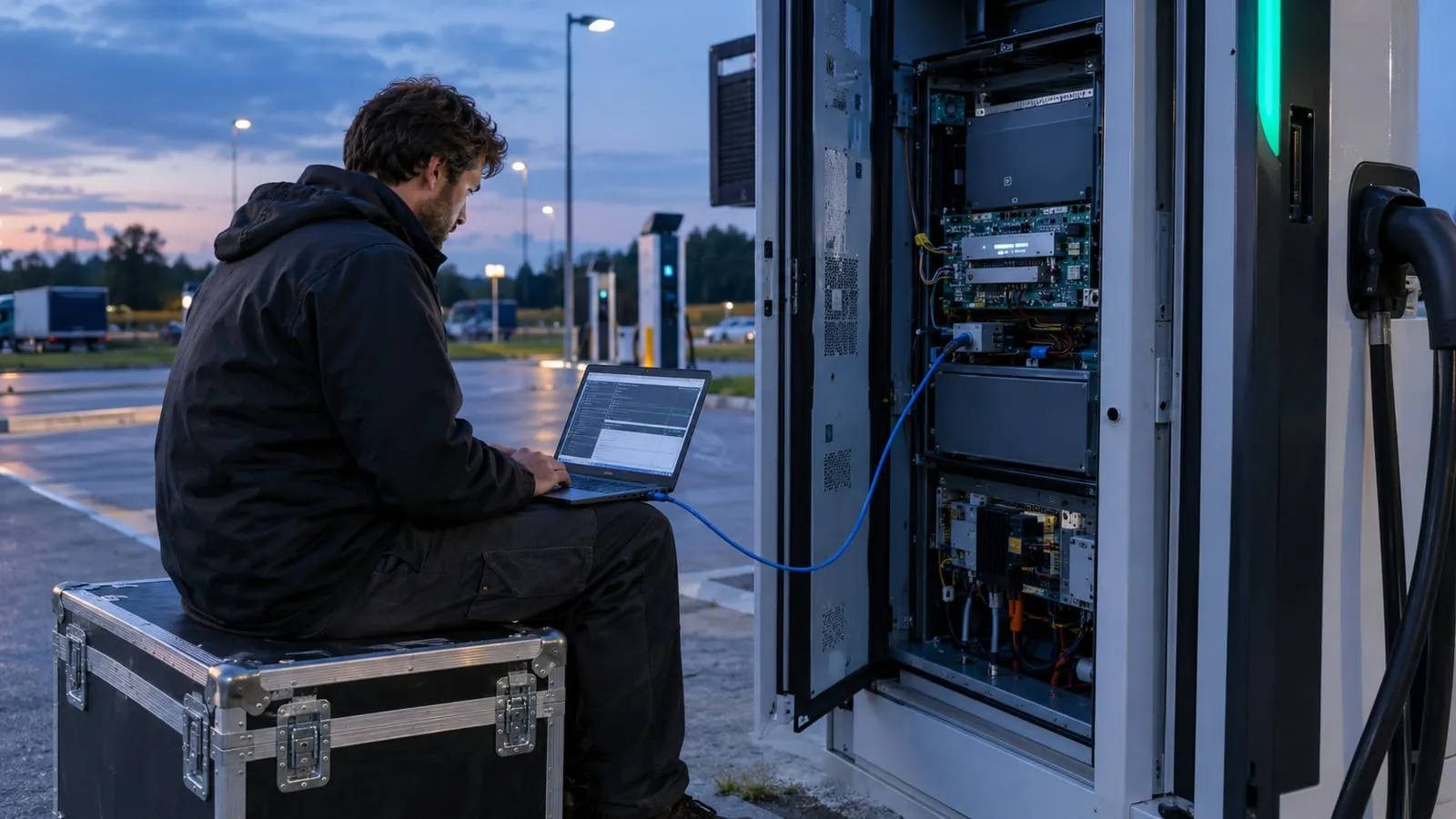
Many incidents come from the installation, not the charger: a service laptop left on the network, a router with a default password, an open port. Segment the charger network from the business network, change defaults and keep a list of what is connected. See charger connectivity options for how the link itself is built.
VULTAE position
VULTAE chargers support OCPP 1.6J and 2.0.1 and communicate over Wi-Fi, 4G and Ethernet. For a project in the EU or UK, tell us the destination and the back end; we will confirm the security features and the available evidence for the exact model before quotation.
Questions buyers ask
- Does the EU require cybersecurity for EV chargers?
- Yes, for chargers that are internet-connected radio equipment, such as those with Wi-Fi or cellular modules. Delegated Regulation (EU) 2022/30 under the Radio Equipment Directive applies from 1 August 2025, and the harmonised standards are EN 18031-1, -2 and -3. The Cyber Resilience Act (Regulation 2024/2847) adds product-wide requirements, with reporting duties from 11 September 2026 and the main obligations from 11 December 2027.
- What are the UK rules for smart charge point security?
- The Electric Vehicles (Smart Charge Points) Regulations 2021 apply to private charge points sold in Great Britain. They require smart functionality, a default off-peak charging schedule and security requirements, and the product must be compliant before sale. Check the GOV.UK guidance for the current details.
- What are OCPP security profiles?
- Profile 1 uses HTTP Basic authentication without transport encryption, Profile 2 adds TLS with server certificate and Basic authentication, and Profile 3 uses TLS with client-side certificates in both directions. Profiles 2 and 3 are recommended for production networks.
- How long should a supplier provide security updates?
- There is no single number, but buyers commonly ask for a stated support period of several years, a security contact and a clear patch process. The EU Cyber Resilience Act will require manufacturers to state the support period.
References
- [1]Commission Delegated Regulation (EU) 2022/30 — cybersecurity of radio equipment. EUR-Lex.
- [2]Regulation (EU) 2024/2847 — Cyber Resilience Act. EUR-Lex.
- [3]Regulations: electric vehicle smart charge points. GOV.UK.
- [4]23 CFR Part 680 — NEVI minimum standards. eCFR.
- [5]Open Charge Point Protocol (OCPP). Open Charge Alliance.