DC Fast Charging
DC Fast Charger Power Factor and Harmonics: What Site Owners Should Know
Power factor and harmonics affect transformer sizing, utility penalties and power quality at DC fast charging sites. What to ask suppliers and the utility.
- Prepared by
- VULTAE Engineering Team
- Published
- Reading time
- 1 min
- Sources
- —
Key takeaways
- 1DC fast chargers convert AC to DC with power electronics. A well-designed unit draws current close to a sine wave and near unity power factor; a poor one adds harmonics and reactive power that the utility may penalise.
- 2Ask the supplier for power factor at full load and at partial load, total harmonic current distortion (THDi) and the test conditions. Data at 100 % load only can hide problems at the loads you will actually run.
- 3Utilities often set limits on harmonics and power factor at the connection point. Check the requirements early because they can affect transformer sizing and filters.
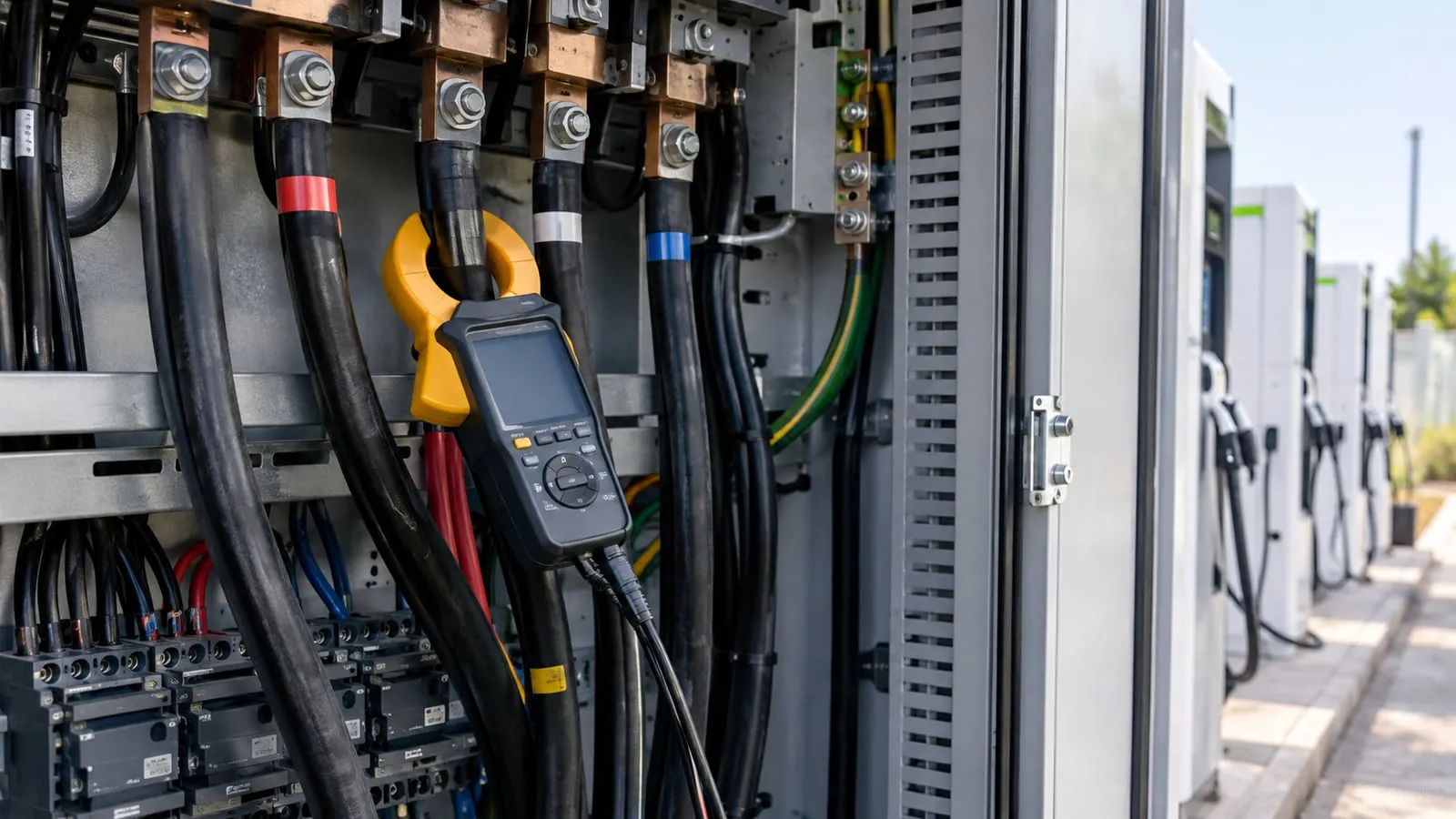
Short answer: a DC fast charger should present a high power factor and low current distortion to the grid. Ask for power factor and THDi at several loads, and check the utility’s connection limits before you size the transformer.
Why it matters
| Effect | Consequence |
|---|---|
| Low power factor | Higher current for the same power; larger cables and transformer; possible utility charges |
| High harmonic current | Extra heating in cables and transformers; interference with other loads; possible connection refusal |
| Poor partial-load behaviour | Problems when chargers run at part power, which is most of the time |
What to ask the supplier
- Power factor at 100 %, 50 % and 20 % load.
- THDi at the same loads.
- Test standard and conditions used.
- Efficiency curve and standby losses — see DC charger efficiency.
- Whether filters or compensation are available as options.
What to ask the utility
- Limits for harmonics and power factor at the connection point.
- Whether reactive power charges apply.
- Whether a power quality study is needed for multi-charger sites.
Site design points
| Item | Action |
|---|---|
| Transformer | Size for apparent power (kVA), not only kW |
| Cables | Allow for current at the real power factor |
| Multiple chargers | Add harmonic effects of all units together |
| Monitoring | Fit a power quality meter at commissioning |
For the grid side of a DC site, read grid power for DC sites and the DC fast charger range.
Questions buyers ask
- What is power factor?
- It is the ratio of real power to apparent power. A value near 1 means the charger uses almost all the current it draws; a lower value means reactive current that loads cables and transformers without delivering energy.
- What are harmonics?
- They are currents at multiples of the grid frequency produced by power electronics. Too many can overheat cables and transformers and disturb other equipment.
- Who sets the limits?
- The utility or network operator, usually in its connection rules, referring to national and international power quality standards. Ask the utility early.