Distributors & Installers
Commercial vs Residential Wallboxes: What Changes in the Spec
What separates a commercial EV charger from a home wallbox: ports, authorisation, billing meters, OCPP, load management, durability and rules.
- Prepared by
- VULTAE Engineering Team
- Published
- Reading time
- 3 min
- Sources
- 3 references
Key takeaways
- 1A home wallbox serves one known driver; a commercial charger serves many unknown drivers. That single difference drives most of the spec: authorisation, billing, back-end connection, durability and load management.
- 2Commercial AC chargers usually add RFID or app authorisation, a meter accurate enough for billing (MID where the law requires it), OCPP to a management system, two ports per unit and IK10 impact protection.
- 3On multi-charger sites, dynamic load management decides how many chargers the existing supply can run — often the biggest cost lever in the whole project.
- 4Installers and distributors can cover both markets with one product family if it offers home and commercial configurations of the same platform.
Contents
Short answer: a residential wallbox charges one household’s car; a commercial charger serves many drivers who must be identified, billed and supported. So commercial chargers typically add RFID or app authorisation, a billing-grade meter, OCPP to a management system, two ports per unit, dynamic load management across the site, IK10 impact protection and better cable management — and they fall under different regulations. The table below lists every line that changes.
Spec by spec
| Item | Residential wallbox | Commercial AC charger |
|---|---|---|
| Users | One household, known | Many drivers, unknown in advance |
| Power per port | 7.4 kW (1-phase) or 11 kW (3-phase) typical; 22 kW where supply allows; 32–48 A in North America | 7.4–22 kW per port |
| Ports | One | Often two per unit (wall or pedestal) |
| Authorisation | Plug and charge, app, sometimes RFID | RFID cards, app, QR, payment terminal |
| Metering | Indicative energy reading | Billing-grade meter; MID or national approval where required |
| Back end | Optional app or cloud | OCPP 1.6J / 2.0.1 to a CPMS |
| Load management | Home load balancing against the house supply | Dynamic load management across many chargers |
| Connector | Often tethered cable | Often Type 2 socket (driver’s cable) or tethered with cable management |
| Durability | IP54–IP65; indoor or sheltered | IP54+ and IK10; vandal-resistant |
| Mounting | Wall | Wall, pedestal or post |
| Display | LED ring, optional screen | Status lights visible from a distance; screen for prices or instructions |
| Regulations (UK example) | Smart Charge Points Regulations 2021 | Smart Charge Points Regulations for private workplace chargers; Public Charge Point Regulations 2023 for public ones |
| Typical buyer | Homeowner, via installer or car dealer | Business, property manager, CPO, municipality |
The four differences that matter most
1. Identifying and billing users
At home, everyone who plugs in is welcome. In a car park, the charger must know who is charging and record how much energy they used. That means RFID or app authorisation, session records sent to the back end, and a meter whose readings can legally be used for billing where the law requires it.
2. Connection to a management system
Commercial chargers almost always connect to a charge point management system (CPMS) over OCPP. The CPMS authorises users, applies tariffs, shares power between chargers, reports faults and pushes firmware updates. OCPP keeps the operator free to change the CPMS without changing the hardware.
3. Load management across the site
Ten 22 kW chargers would need 220 kW if all ran at once. Few buildings have that spare capacity. Dynamic load management caps the total and shares it between active sessions, often letting a site install twice as many chargers on the same supply. Ask whether load management runs locally (in a site controller or a master charger) and whether it keeps working if the internet connection drops.
4. Built for strangers
Public and semi-public chargers are dropped, bumped, rained on and occasionally vandalised. IK10 impact rating, sockets with shutters or robust tethered cables with holsters, and clear status lights reduce faults and support calls.

One product family for installers and distributors
Installers and distributors usually sell both: home wallboxes to homeowners and commercial units to businesses. Carrying one platform in home and commercial configurations simplifies training, stock and support:
| Configuration | Typical use |
|---|---|
| Single-port smart wallbox, app control | Homes |
| Same wallbox with RFID, OCPP and LCD | Small businesses, workplaces, apartment car parks |
| Dual-port wall unit with metering options | Offices, hotels, retail car parks |
| Dual-port pedestal | Open car parks, on-street, destinations |
The VULTAE AC range
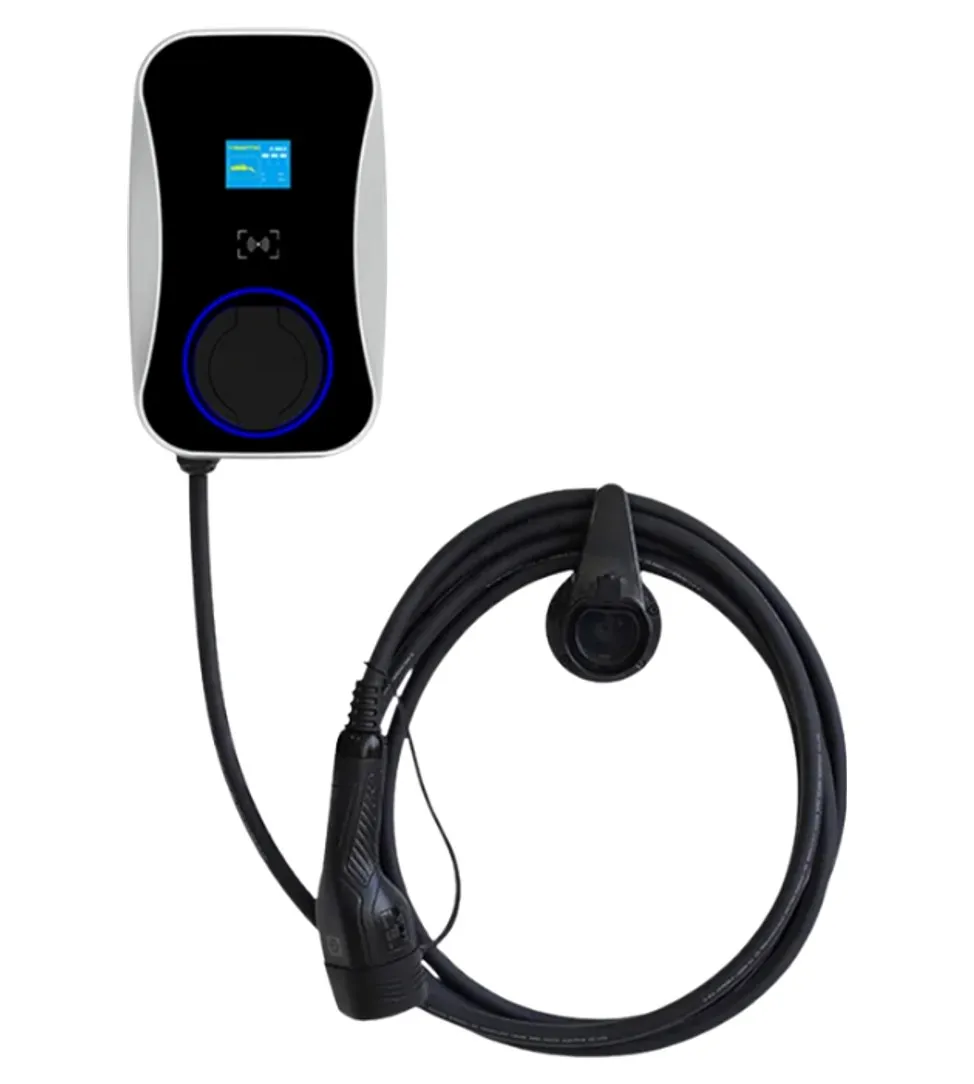
- VT-HW smart wallbox: 3.7–22 kW (IEC) and 32–48 A (North America), Type 2 socket or tethered, RFID / app / plug-and-charge start, OCPP 1.6J / 2.0.1 — for homes and small commercial sites.
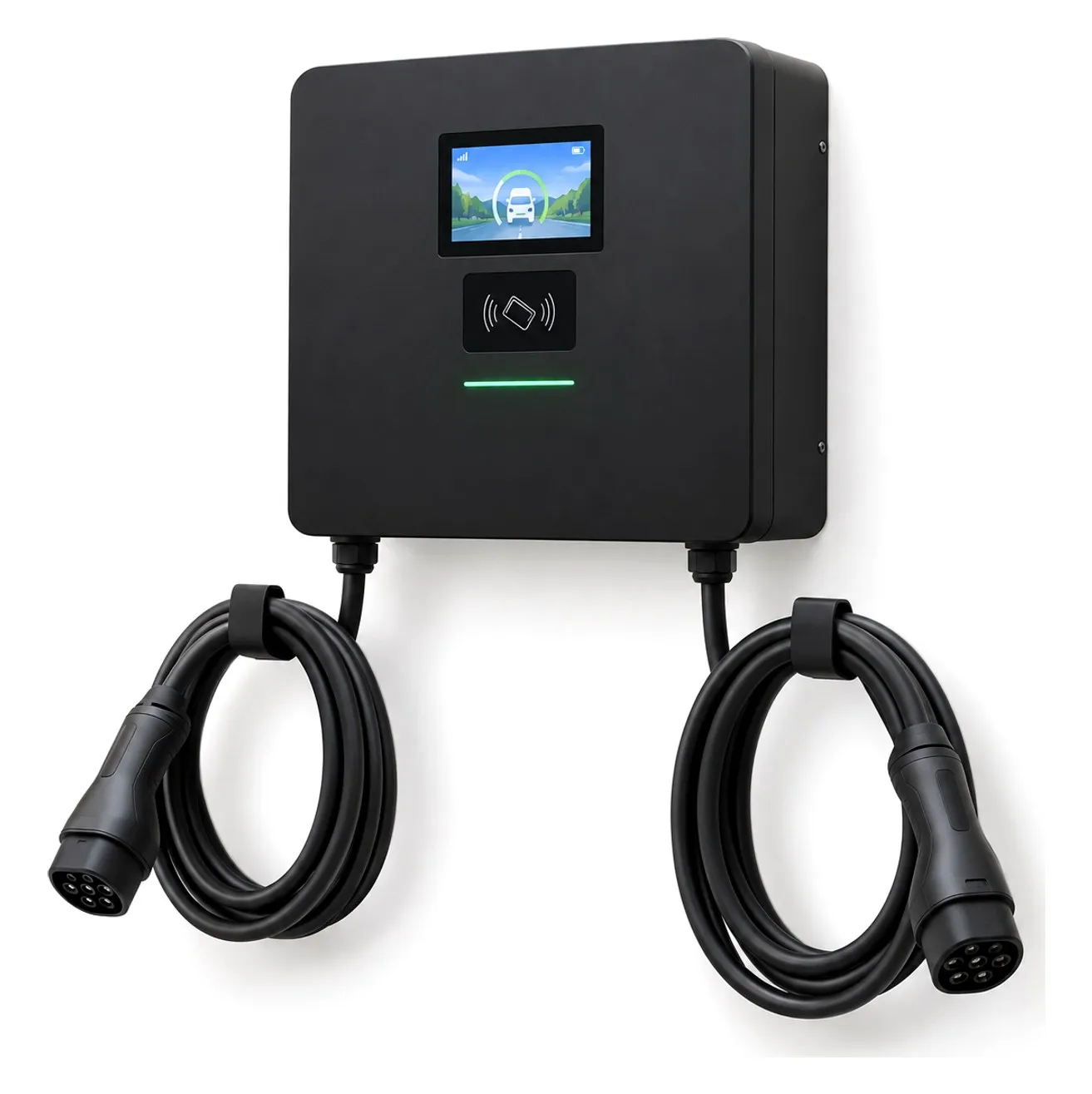
- VT-CW dual-port wall charger: 2 × 3.7–22 kW, IP55 / IK10, payment terminal and MID-certified meter options.
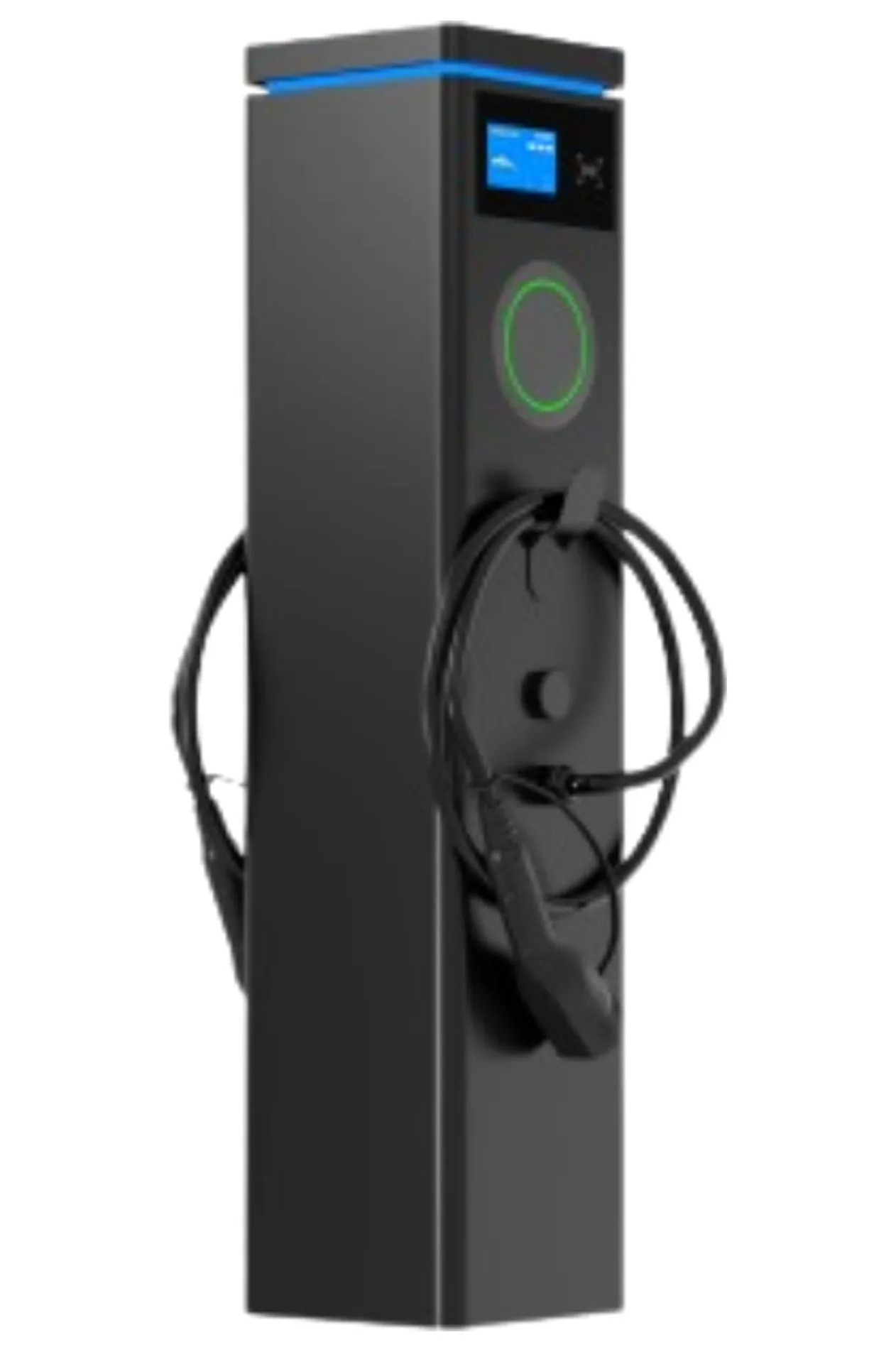
- VT-CP dual-port pedestal: 2 × 3.7–22 kW, IP55 / IK10, two LCD displays, payment terminal and MID-certified meter options.
All are available as OEM / private label. See the AC charger range and our page for distributors and installers.
Questions buyers ask
- Can I use a home wallbox for a business?
- For a small private car park with known users, a smart home wallbox with RFID and OCPP can work. For shared or public use you usually need billing-grade metering, robust authorisation, a back-end connection, higher impact resistance and often two ports per unit.
- What power do commercial AC chargers have?
- Usually 7.4 kW single-phase or 11–22 kW three-phase per port, often with two ports per unit. Site load management typically shares the available supply between all ports.
- Do commercial chargers need a MID meter?
- Where drivers are billed per kWh, many European countries require a MID-approved meter, and Germany requires Eichrecht-compliant metering for public charging. Elsewhere, local metrology rules apply — for example NIST Handbook 44 in many US states.
- Why do commercial chargers need OCPP?
- OCPP connects the charger to a charge point management system that authorises users, records sessions for billing, applies load management and lets the operator monitor and fix faults remotely, independent of the hardware brand.
- What is the difference between a socket and a tethered charger?
- A socketed charger has a Type 2 socket and drivers bring their own cable — common for public and workplace posts. A tethered charger has its cable attached — more convenient and common at home, but the cable is a wear part that must be replaced if damaged.
References
- [1]Regulations: electric vehicle smart charge points. GOV.UK.
- [2]Measuring Instruments Directive 2014/32/EU. EUR-Lex.
- [3]OCPP — Open Charge Point Protocol. Open Charge Alliance.